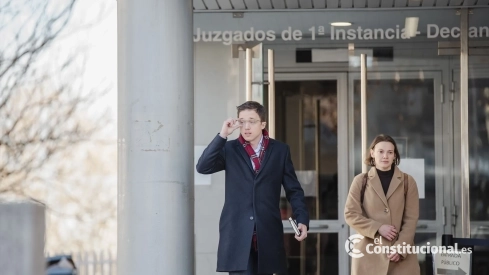
This Tuesday, actress Elisa Mouliáa published a statement on her social media announcing her decision to withdraw the private prosecution in the sexual abuse case against Íñigo Errejón: "I have decided to withdraw my private prosecution in the sexual abuse case against Íñigo Errejón. It is not a retraction, it is a limit"In his X profile he also attached an image of the writing, from which it is clear that the reasons for withdrawal are personal and health-related
OFFICIAL STATEMENT
— Elisa Mouliaá (@ElisaMouliaa) February 4, 2026
I have decided to withdraw my private prosecution in the sexual abuse proceedings against Íñigo Errejón. It is not a retraction, it is a limit.
The Prosecutor's Office determined the veracity of the facts and Judge Carretero found indications of criminality sending him to the… pic.twitter.com/YW3shVnvfv
According to sources from the investigation in Plaza de Castilla, said document has not yet reached the investigating magistrate Adolfo Carretero, therefore, it has not been transferred to the rest of the parties. For this reason, we return to the typewriter to tell you what is likely to happen in the already known "Errejón Case".In its indictment, the actress requested a sentence of three years in prison for a continuous offense of sexual abuse. For its part, the Prosecutor's Office did not find evidence of a crime and Errejón's defense sought his acquittal.
However, there is one more actor in this equation: **popular accusation**, exercised by the association **Adive** (Specialized Integral Defense Association of Victims), which continues to be involved in the criminal proceedings
Our legal system allows the exercise of popular action even when the person exercising it is not the direct victim of the crime, as is the case here. In practice, and if Mouliáa's withdrawal is confirmed —pending acceptance by Judge Carretero—, the popular prosecution would be the only party to pursue criminal action in a potential trial, given that the Prosecutor's Office does not perceive any crime. The question, therefore, is clear: will Errejón be put on trial?
Second section
Just as we pointed out in the previous section, the popular accusation is maintained, however, the **Supreme Court** **has already delimited that the individual interest** of a specific case must be defended by the directly affected person, that is, the private accusation or through the prosecution, while the general, collective, or group interest defended by the popular accusation decays when neither the private accusation nor the public prosecutor promote criminal action.One example among others, is the well-known "Botín Doctrine", which arose from the proceedings in which Emilio Botín was investigated for an alleged tax offense and which marked the way courts acted in those situations where the popular accusation remains the sole driver of the procedure. In the Errejón case, a similar situation could occur
However, the definitive answer to the question of whether or not there will be a trial against the former Sumar deputy is now in the hands of the Provincial Court of Madrid, which must resolve the appeal filed against his prosecution
This coming Monday, its **deliberation** is scheduled and, if the court finally considers that the **processing** is appropriate, the popular prosecution could achieve that Errejón sits on the bench, although the defense **will always be able to invoke the Supreme Court's interpretation** on how judges should act in these types of scenariosOn the contrary, if the Provincial Court of Madrid concludes that **the prosecution is not appropriate**, the Errejón case will be definitively **archived**
