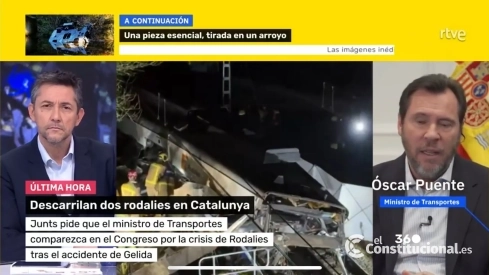
The Minister of Transport and Sustainable Mobility, Óscar Puente, confirmed this Wednesday that the investigation into the railway accident in Adamuz (Córdoba) has detected visible marks on the wheels of the first five wagons of the Iryo high-speed train. He also indicated that it is “possible” that two or three trains that passed through the same section before the accident show similar abrasions, although he stressed that it is still not possible to determine with certainty what caused these marks or if they are directly related to the derailment.
The accident occurred last Sunday at kilometer 318 of the Madrid-Seville high-speed line, when the Iryo train traveling from Málaga to Madrid derailed and invaded the opposite track, colliding seconds later with an Alvia train traveling in the opposite direction. The incident has caused 42 fatalities and dozens of injuries.
In relation to the audio broadcast yesterday, in which the Iryo train driver is heard communicating with Adif's command center at Renfe, Puente explained that between the first call, in which the worker indicated that he had stopped the train after noticing a "snag," and the second, in which he confirmed that the rear carriages had derailed, invading the opposite track and with fire in one of them, approximately "three or four minutes" had passed. The minister also clarified that the interval between the Iryo derailment and the collision with the Alvia train was not 20 seconds, as initially estimated, but rather about 9 seconds, which would explain why during both communications the driver had not yet perceived the magnitude of the impact
For now, authorities are limited to analyzing the marks on the bogies and the accident data. So far, **it has not been determined if these marks are related to the derailment**, and the investigation remains open to clarify all aspects of the incident
Add ElConstitucional.es as a preferred Google source for free.
Stay informed about all the latest breaking news with the best information. Against disinformation, for democracy and social rights.