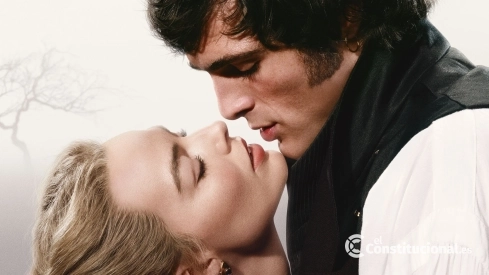
The filmmaker Emerald Fennell, responsible for films such as Promising Young Woman and Saltburn, has unleashed a wide conversation around her next film “Wuthering Heights”, whose arrival in theaters is scheduled for February 13, 2026, partially replacing the classic title without forgetting its original literary legacy
The reason for the quotation marks around the title —which have generated theories and debate among fans of the original book by Emily Brontë*— is not a typographical error, but a statement of intent from the director. Fennell has explained that, although she deeply admires the novel, she considers that “it is not possible” to faithfully adapt such a dense, complex, and emotionally charged book to the screen, so she prefers to describe her work as a personal version of the story.
According to Fennell, the use of quotation marks signals precisely that creative distance and artistic freedom that is taken when reinterpreting a classic. "I can't say I'm doing *Wuthering Heights*. What I can say is that I'm doing a version," said the director, emphasizing that her film dialogues with the original work rather than reproducing it literally.The film, starring Margot Robbie and Jacob Elordi, has generated comments for its aesthetic and narrative choices, as well as for the modern soundtrack by Charli XCX, designed to connect emotionally with the contemporary audience. Furthermore, the adaptation emphasizes the complexity of the characters, especially Catherine, whose rebellion and contradictions make her a symbol of autonomy and passion that continues to resonate today. The film thus allows experiencing the emotional storm of the novel, without losing sight of the rawness, drama, and beauty that have made Wuthering Heights a timeless story.With the premiere just around the corner, Fennell herself has defended that a film adaptation is always a personal reading and that, through the use of quotation marks, she wants to respect both the fans of the novel and her own creative vision, marked by an emotional reinterpretation rather than historical or structural fidelity to Brontë's text.
Add ElConstitucional.es as a preferred Google source for free.
Stay informed about all the latest breaking news with the best information. Against disinformation, for democracy and social rights.