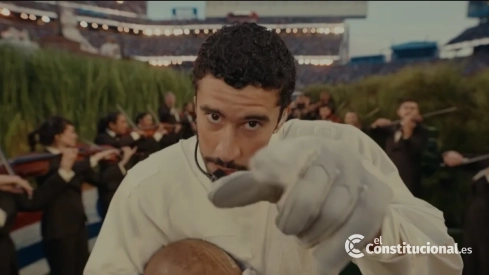
Santa Clara, California — In what will be remembered as one of the most impactful cultural moments of the year, Bad Bunny transformed the halftime show of Super Bowl LX into a vibrant celebration of Latin identity, mixing music, cultural symbols, and messages with social significance before a global audience estimated in the tens of millions. The Puerto Rican artist took the stage at Levi’s Stadium dressed in white and holding an American football as his first gesture, beginning his performance with his hit Tití Me Preguntó in an atmosphere that evoked the landscapes, fields, and sounds of the Caribbean and Puerto Rico. From there, the show became a party of urban rhythms, salsa, and reggaeton, with carefully designed choreography and a setlist that included his most popular songs as well as tributes to genre pioneers. Each song, each step, and each gesture reinforced the feeling that Latin music was occupying a space that had rarely been given to it on a stage of such magnitude.
What could have been simply a collection of hits transformed into an act of cultural reaffirmation. The stage design recreated iconic elements of Puerto Rican and Latin American life, and the music dialogued with the history and experiences of these communities in the United States. Bad Bunny, who sang almost entirely in Spanish —something unprecedented at this event— made millions of viewers accustomed to English-dominated performances feel his pride in his roots and the value of the language.
The appearance of surprise guests enhanced the staging and conveyed a clear symbolism: immediately after the celebration of a royal wedding live, Lady Gaga burst onto the stage to sing and dance salsa with Bad Bunny, adapting her hit Die With a Smile to Latin rhythms: Anglo-Saxon mainstream coexisting with Latin music;
Lady Gaga's entrance was the most ICONIC. #SuperBowl pic.twitter.com/tW8O323AGK
— David;⚡⁷ | VI A LADY GAGA (@GAGAXBTS) February 9, 2026
Ricky Martin, as a Puerto Rican “brother,” contributed an emotional and generational link by performing fragments of his classic Lo que le pasó a Hawái, reinforcing shared roots and the continuity of a Latin music that does not break in: it consolidates;
Meanwhile, at La Casita, Jessica Alba, Cardi B, Karol G, Pedro Pascal and Young Miko were seen enjoying and dancing to the rhythm of the show, representing the diversity of America and mutual support among colleagues, functioning as a symbol of fraternity, unity, and presenceThe closing of the performance was loaded with symbolism, with Bad Bunny raising the flag of Puerto Rico surrounded by the rest of the Latin American flags, while he held a ball that had the slogan “Together we are America” printed on it and on the stage the message “The only thing more powerful than hate is love” was projected. This image condensed the entire spirit of the show: unity, identity, pride, and belonging. In a country where immigration policies and the actions of agencies like ICE generate constant tensions, Bad Bunny's gesture did not appeal to direct confrontation but to the idea of shared belonging and the need for representation matters, especially when millions of people live under pressure and thousands of Latin American voices are being silenced
The symbolism of music versus the power that decides who is American
Behind the music and the show there are several reflections that this performance leaves to the public and the entertainment industry. Latin culture no longer just accompanies, nor is it an accessory: it leads, showing its capacity to speak to global audiences without needing to adapt culturally or linguistically to traditional molds. Bad Bunny's decision to sing in Spanish, to highlight his roots, and to put such an intense and rich narrative on stage confirms that **language is not a barrier** when music and emotion connect universally. Beyond the strictly musical, the act is perceived as a declaration of cultural identity and a claim for visibility, something that resonates strongly at a time when discussions about migration, inclusion, and representation occupy a place of concern in the worldThe last shot of the ball with the slogan **“Together we are America”** finished condensing the political and emotional message of the night while flags from different countries of the continent waved around in an image designed to dialogue with the present of the United States and with the reality of millions of Latinos who are part of the social fabric of the country. **Bad Bunny managed, in just thirteen minutes, to turn the halftime show into something more than entertainment: into a message of Latin pride, unity, and presence in the heart of global popular culture**, reaffirming that representation and cultural identity can no longer be left out of the national narrative and that **power from above can no longer decide who belongs and who does not**In short, Bad Bunny's performance at Super Bowl LX will go down in history not only for its energy and stellar collaborations, but for having reconfigured the way Latin music is presented and perceived on the most-watched stage in global sports entertainment, and for having done so with authenticity, passion, and a message that goes beyond music, in the current sociopolitical context. "My name is Benito Martínez Ocasio and if I am here today at Super Bowl 60 it is because I never, ever stopped believing in myself. You should also believe in yourself. You are worth more than you think. Believe me". For anyone—especially a Latino child, like the one to whom Bad Bunny hands a Grammy in the middle of the show—hearing this is more than inspiration: it is a reminder that their dreams matter and that their culture and effort have value, even in the face of those who think otherwise