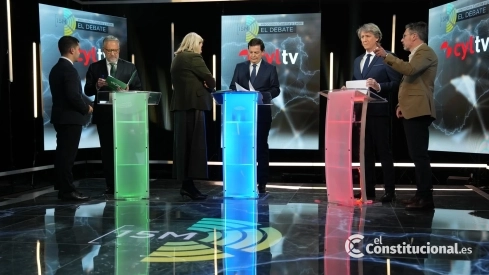
The Castilla y León election campaign has come to a close with a day of strong political and symbolic significance in Valladolid, where PP, PSOE, Vox and Podemos have concentrated their final events alongside national leaders. The day brings to a close a campaign marked by the constant presence of state leaders, the debates between candidates, and each party's attempt to mobilize its electorate in the final hours before Sunday's vote March 15.
The PP has focused its strategy on mobilizing its electorate in the final stretch of the campaign. The popular candidate and president of the Junta, Alfonso Fernández Mañueco, has participated in events accompanied by the national leader of the party, Alberto Núñez Feijóo, from where he has appealed to concentrate the vote on the PP to guarantee “stability” in the community's government. During the rallies, the popular party members have defended their management at the head of the regional Executive and have asked for broad support at the polls to be able to continue governing.
From the PSOE, its candidate Carlos Martínez has insisted on the need for political change in Castilla y León after years of PP governments. The socialist leader has focused his campaign on proposals to strengthen public healthcare, improve education, and fight against depopulation, one of the community's main problems. During the electoral events, the socialists have argued that these elections represent an opportunity to open a new political stage in the region.
Vox has also participated in the campaign closing events with the presence of its national leader, Santiago Abascal, who has supported the party's candidate in Castilla y León. During his speech, the Vox leader attacked the central Government's policies and defended his party's program for the community, insisting on issues such as security, economic policy, and the reduction of political spending.
For its part, Podemos-Alianza Verde (Podemos-AV) has also held campaign events with the participation of national leaders of the party. The party has focused its discourse on the defense of public services, access to housing, and the need to strengthen social policies, while also appealing to the mobilization of the progressive electorate in the final days before the elections.
The platform Soria ¡Ya! has also continued with its campaign agenda demanding greater institutional attention for the province. The party has insisted on the need to adopt specific measures against depopulation and to promote public investments that allow reversing the demographic and economic decline affecting large areas of the community.
From UPL (Union of the Leonese People), the party has focused its discourse on the defense of the interests of the Leonese region and on the claim for greater political weight for León within the community. During the campaign, the formation has once again demanded policies that boost economic development and curb population loss in the province.
Likewise, Por Ávila has participated in the campaign with acts aimed at defending the interests of its province. The party has focused on the need to improve infrastructure, strengthen public services, and promote initiatives that boost economic activity and employment in the Ávila region.
Beyond the specific acts of the last day, the campaign has been marked by a strong involvement of national leaders from the different parties and by debates that have gone beyond the autonomous sphere. Throughout the last weeks numerous political leaders have participated in the campaign, which has contributed to intensifying the confrontation and to place the elections of Castilla y León at the center of the national political debate.
The campaign closing thus represents the last opportunity for parties to mobilize their voters and try to attract undecided voters before election day. With the final events held, the parties now face the hours leading up to the vote in a community where the result could depend as much on turnout as on the subsequent ability of the parties to reach government agreements.
