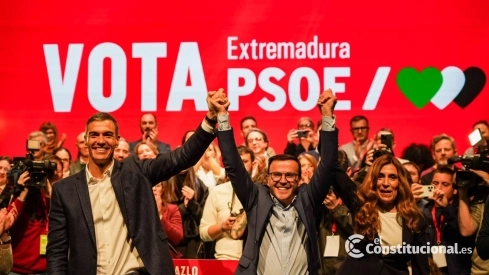
The PSOE of Extremadura arrives at April 11 with something more than an organic handover at stake. What is decided that day, when the militancy votes between Soraya Vega and Álvaro Sánchez Cotrina, is whether the party chooses to manage the legacy of Miguel Ángel Gallardo or if, on the contrary, it opens a new political stage after his departure. More than 9,000 militants are called to vote, 6,000 in Badajoz and 3,000 in Cáceres.
Because even though Gallardo is no longer there, his shadow runs through the entire campaign. His resignation, after the worst recent electoral result for Extremaduran socialism, has not closed the cycle, but has left it in suspense. And now it is the grassroots who have to decide whether that cycle is corrected or brought to an end.
In this way, Pedro Sánchez's name also carries weight, even if it does not appear on any ballot. Ferraz has closely followed the process, initially trying to avoid an internal confrontation that has ultimately been inevitable. The failure of that path, that of a consensus candidacy, is one of the first indications that these primaries were going to have more political depth than expected.
This internal process starts with up to five pre-candidacies, a reflection of a fragmented federation and in full search of direction. To the aspirations of Soraya Vega Ramos and Álvaro Sánchez Cotrina, Blanca Martín, Manuel José González Andrade and Ramón Díaz Farías initially joined. During those first stages, the party experienced a probing phase, with cross-contacts and discreet movements to explore alliances and avoid an excessive dispersion of the internal vote.
That scenario began to clear up soon. First came the strategic withdrawals: Blanca Martín, president of the Assembly of Extremadura between 2015 and January 2026, decided to step back and join Sánchez Cotrina's candidacy twelve hours before the deadline for the presentation of endorsements in Mérida . Shortly after, Manuel José González Andrade, mayor of Olivenza, followed the same path, thus reinforcing the idea of an alternative candidacy with the capacity to group different sensibilities of the party.
The next filter was that of endorsements. With a required minimum exceeding a thousand signatures, Ramón Díaz Farías, mayor of Villanueva del Fresno and vice-president of the Provincial Council of Badajoz, was out of the race for not reaching the necessary threshold. His exclusion finished configuring a clear scenario: a face-off between two candidacies, with no room for third ways.
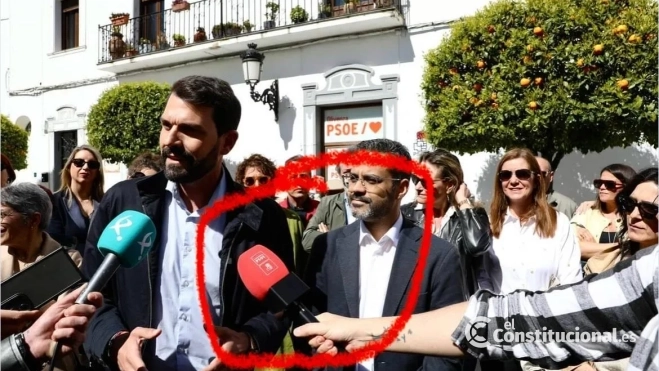
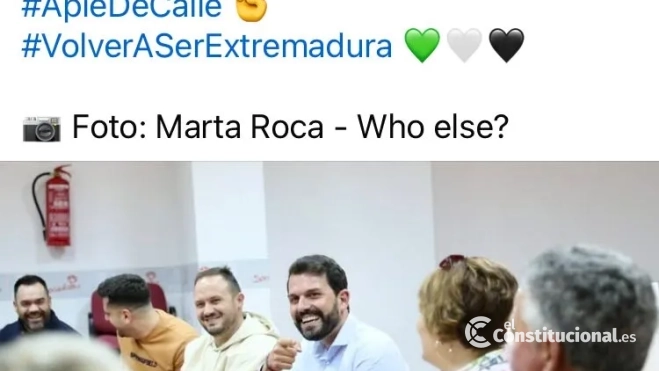
It was not a process free of controversy. During the primaries, criticism also arose regarding the use of images and party tools by some pre-candidacies, in reference to the presence of communication teams and organic resources in campaign events. It was pointed out, for example, that Cotrina had been accompanied by members of the Cáceres Provincial Press using the organization's media, such as the appearance of an identifiable microphone in disseminated images and a screenshot of a comment that attributed the authorship of the photograph to Marta Domínguez Roca, a management technician for the Provincial Council and collaborator of the Cáceres Provincial. These practices could generate a situation of inequality in the collection of endorsements, by favoring those who could supposedly count on greater internal support.
Extremadura's PSOE arrives at April 11 with a fairly defined dilemma. On one hand, Soraya Vega, current spokesperson for Extremadura's PSOE, represents a recognizable option for a good part of the party's structure. Her candidacy relies especially on the organic weight of Badajoz and offers an orderly transition, without major ruptures. It is not an automatic continuity of Gallardo, but rather a proposal that preserves a good part of the existing internal balances. It is, in essence, an adapted continuism.
Facing her, Álvaro Sánchez Cotrina, deputy in the Assembly of Extremadura and based in Cáceres, has built a candidacy that presents itself as the beginning of a new stage. His discourse insists on decentralization, on territorial rebalancing and on the need to rebuild the party from below. Added to this is the integration of other sectors, which allows him to project himself as a broad alternative.
Amidst this contrast, Pedro Sánchez's role appears as a backdrop. The result will not be irrelevant for Ferraz, which needs to stabilize a key federation after a turbulent period. What happens in Extremadura will also be interpreted as a signal about the balance between the federal leadership and the party's territorial dynamics.
April 11 will not solve all the problems of the Extremaduran PSOE, but it will mark the beginning of its next phase. It will be the moment when the organization decides if it wants to recompose itself on known structures or if it opts to redefine itself with new internal balances. The challenge is the same: to rebuild a competitive PSOE in Extremadura.
