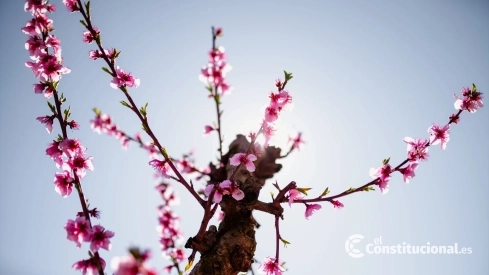
After weeks marked by rains and low temperatures, winter reaches its final stretch and gives way to one of the most anticipated dates on the calendar. Spring 2026 already has an exact start day and time, a moment that is determined by the equinox and that marks the beginning of increasingly longer days in Spain.
Along with that change of season, there are other key elements that should be taken into account: how long spring will last this year and when the change to daylight saving time will occur.
When spring 2026 starts: exact date and time
Spring 2026 will begin on Friday, March 20 at 3:46 PM in peninsular Spain.
It is not an approximate estimate, but a precise astronomical calculation that sets the moment when the Sun crosses the celestial equator. This phenomenon is known as the spring equinox and it is what marks the official start of the season.
At that instant, day and night have practically the same duration across the entire planet. From then on, the northern hemisphere begins to progressively receive more hours of light.
The equinox is the result of the Earth's movement around the Sun. At that specific point in the orbit, both hemispheres receive a similar amount of solar radiation.
From that moment on, the inclination of the northern hemisphere towards the Sun gradually becomes more pronounced. This translates into a progressive change that is perceived without the need to look at the calendar: the hours of daylight increase, the sunset is delayed, and the days lengthen.
Although in the first days of spring episodes of cold or rain can still be registered, the change in trend is clear. Average temperatures begin to rise gradually and the natural environment begins to transform.
How long does spring last in 2026
The spring of 2026 will extend from March 20 until June 21, date on which summer will begin.
If measured with astronomical precision, it will have a duration of 92 days and a little over 18 hours. It is not an exact figure each year, as it depends on the actual path of the Earth in its orbit around the Sun.
During this period an easily perceptible phenomenon occurs: the day progressively gains ground on the night. By the end of March, dusk still arrives relatively early, but week after week it gets later.
In June, the difference is evident. The evenings lengthen until well into the night in many areas of Spain, reaching their peak on the summer solstice of June 21, which marks the day with the most hours of daylight of the year.
Time change in spring 2026: when it occurs
The beginning of spring comes accompanied by another important change: the switch to daylight saving time.
In 2026, this adjustment will be made in the early morning of Sunday, March 29, when clocks must be moved forward one hour. At 02:00 they will become 03:00, so that time slot disappears.
This change means sleeping one hour less that night, but in return the afternoons will have more light from that same day.
The advancement of the clock does not modify the movement of the Earth, but it does change the way in which we perceive natural light.
From the time change, the sun will set later, which lengthens the feeling of day. This adjustment seeks to concentrate activity in the hours with greater light, something that is especially noticed in spring and summer.
Daylight Saving Time will be maintained until October 25, 2026, when the reverse change will be made and the clocks will be set back one hour.
Although the calendar sets an exact moment for the beginning of spring, its effects are not perceived immediately.
The increase in daylight hours, the rise in temperatures, and changes in the environment occur gradually. Each day adds a few more minutes of daylight and the daily rhythm gradually adapts to longer days.
It is a continuous change, which becomes evident with the passing of the weeks until reaching its maximum point with the arrival of summer.
Add ElConstitucional.es as a preferred Google source for free.
Stay informed about all the latest breaking news with the best information. Against disinformation, for democracy and social rights.
