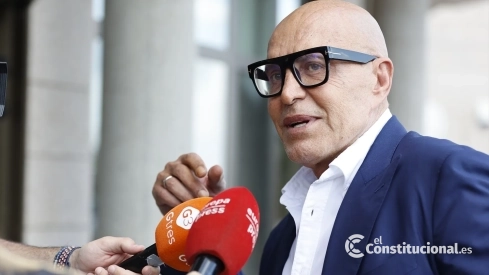
ElConstitucional.es conducts an exclusive interview with Kiko Matamoros in which he addresses, from a public and media perspective, the allegations against Julio Iglesias.
Question, ElConstitucional.es: Regarding the recent accusations against Julio Iglesias, are you surprised, or do they align with the image you had of him?
Response, Kiko Matamoros. Well, I have an image that has been conveyed to me by people who have lived with him, who have cohabited with him, and people who have had sporadic relationships with him. In this case, I'm talking about women who have had sporadic relationships. So, I want to tell you that, of course, I was surprised, obviously, by the issue of violence exerted, etc. But the practices that are denounced or that are revealed in the sexual realm have not surprised me. That is to say, obviously I am not giving credence to the testimony, but it would fit with his way of understanding sexual relations. Obviously, it is part of his intimacy, but in this case, it is a public matter. And I'm answering you because it makes me doubt whether it's a false accusation; I don't know. That, obviously, is too late to know.
Q. And how do you think this news might be affecting him and those around him?
**R.** Well, yesterday I heard a joke on a TV show, almost at the end, that said in these cases the one who suffered the most was Julio Iglesias's wife. I still can't believe the things that exist. And I think here we need to emphasize solidarity, understanding, and empathy with the accusers, because they are not accusing just anyone: they are accusing a gentleman who has excellent relations at all levels and a lot of power.
Q. And if they are true, do you think these actions could be related to some trauma, some psychological problem, or, failing that, to fame or the environment?
R. No, I don't think fame changes people's sexual behavior or is the determining factor. I'm not a psychologist, but from what I know and what I've experienced, I believe there are other factors that carry much more weight. Subjugation, which is also identified in psychology, is a disorder that stems from a complex. It's possible that, despite being a successful person in life and professionally brilliant, certain insecurities are carried along that manifest externally or in the intimate need to succeed in some aspect of life and be dominant in others, where disadvantages or weaknesses are understood to exist, whether physiological or psychological, compared to the common mortal.
Q. Regarding media exposure, in these types of cases, it often influences public opinion long before justice declares any kind of guilt.
R. The news penalty.
Q. Of course. And from journalism and the institutions that comment on these cases, do you think the presumption of innocence is being respected, or are people being prejudged before justice has ruled?
R. We all prejudge. Another thing is whether we voice it. An input reaches you and there's an automatic response. I'm convinced that when you heard the news, you had an internal reaction and thought whether it seemed credible, incredible, or if you thought it was the victim of a conspiracy. We all do that. Another thing is to take it to the public sphere. I give a certain degree of plausibility to the accusation due to a confluence of circumstances that I know and that have been shared with me in private and that I am not going to make public. I wouldn't be surprised; that possibility exists.
Q. And precisely on this, what do you think the role of the media and institutions should be in cases like this? To report on what has been investigated journalistically or to wait for the justice system to make a pronouncement?
R. The complaint must be filed. The media have an obligation to report these things when they happen, whether through indirect or direct knowledge, in this case through the testimony of the alleged victims. However, the proper thing to do on a personal, legal, and ethical level is to also file a complaint in court, if not simultaneously, then at least after the events are reported to the public. We are talking about women who appear hidden behind a substituted voice and an image that is not theirs. I assume all of this will have a basis and support, and that neither the media outlet that reported it there nor the one that reported it here will have left their backs uncovered. They will have a signed statement and authorization to broadcast that recording, whether it is a real voice or one generated by artificial intelligence. In any case, they make those words their own.
Q. In fact, the Prosecutor's Office has admitted the complaint and now everything is in the hands of justice.
R. I believe—correct me if I'm wrong—that the Prosecutor's Office has acted ex officio and that the National Court is involved. We will have to see if the circumstances in international law are met and the correspondence with countries like the Bahamas or Santo Domingo, where the events allegedly occurred.
We also need to look at precedents and many factors for a trial to be opened here. Honestly, I see it as remote, given my knowledge of law. And regarding the media, I think we have a social problem of discourse radicalization. We are not capable of lifting a finger for the suffering of women in Iraq or for the denial of evident dictatorships like that of Venezuela, where there are torture centers, political prisoners, and censorship. However, there are those who deny it publicly with complete shamelessness.
Q. There's also everything these testimonies imply, with debates about cancel culture.
R. Of course. We live in that. And I believe it is a social and ethical duty to leave a better society for those who come after us. I would refuse to be part of the firing squad until there is at least some judicial movement.
Then everyone is free to give their opinion, go to a concert, listen to a song on Spotify, or buy a poster. But I am not in favor of lynching. To end someone's civil life, one must allow some leeway and see what we are talking about, who it is about, and under what circumstances.
I am not defending Julio Iglesias; I am making a collective defense.
Q. Against lynching, of course.
R. Yes. In this country, we are very fond of kicking a man when he's down, and we always have been. It's tradition. I think we should be cautious. I myself have often participated in actions that I later thought about and felt ashamed of.
Q. It's also okay to regret it. Thank you very much for your time, Kiko. From El Constitucional, we hope that justice will determine what it has to determine, and we will continue to report with rigor.
R. If that action is viable, which I don't know for sure. But I think you have a television section, don't you?
Q. Yes.
R. Well, soon we'll invite you to the presentation of a streaming program that will revolutionize what's out there so far. Thank you very much.