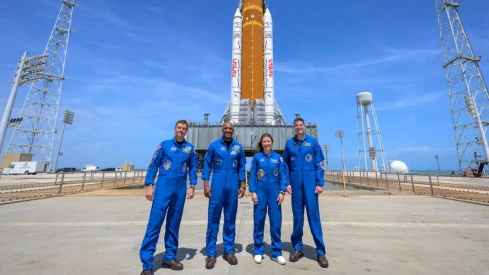
This Monday, April 6, 2026, the world will witness one of the most anticipated milestones in modern space exploration: the lunar flyby of the Artemis II mission. The Orion spacecraft, with four astronauts on board, will reach its closest point to the Moon's surface in a critical maneuver that will mark the success of this historic mission.
On board travel Reid Wiseman, Victor Glover and Christina Koch, from NASA, along with Jeremy Hansen, from the Canadian Space Agency. This team will be the first in decades to travel so far from Earth, venturing into deep space with a mission designed to validate the systems that will allow future human expeditions to the satellite.
The most impactful moment of the trip will be the passage through the far side of the Moon, a region invisible from our planet. During that instant, the spacecraft will be briefly incommunicado, while lunar gravity acts as a “natural catapult” that redirects its trajectory back to Earth in a path known as free return.
For the first time, this type of event can be followed live from a massive streaming platform. Netflix will broadcast the flyby thanks to its agreement with NASA, integrating the NASA+ Live signal. The broadcast will include real-time images, technical data, and detailed tracking of the spacecraft during the approach that in Spain can be followed from 10:00 PM.
Unlike what many might expect, this mission does not include a moon landing. Artemis II is a fundamental test to evaluate the safety and capability of the Orion spacecraft and the SLS rocket. The main objective is to ensure that astronauts can survive and operate in the deep space environment before attempting more complex missions.
The return of the spacecraft is scheduled for April 10, when it lands in the Pacific Ocean. This journey not only represents a technological advance, but also a decisive step towards the return of humans to the Moon, planned in future missions of the Artemis program.
Add ElConstitucional.es as a preferred Google source for free.
Stay informed about all the latest breaking news with the best information. Against disinformation, for democracy and social rights.
