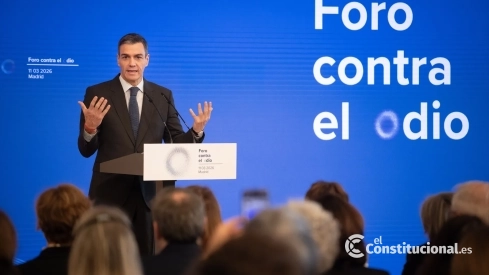
HODIO, acronym for Footprint of Hate and Polarization, is a tool created by the Government to observe how hate speech circulates on the main digital platforms used in Spain. Its function is not, according to the information disseminated, to delete messages or directly sanction users, but to systematically measure how much hate appears on each network, how it evolves, and to what extent that content achieves dissemination and impact. The President of the Government, Pedro Sánchez, presented it during the Summit against Hate and explained that it will serve to “systematically measure the presence, evolution, and also the amplification and impact of these hate speeches on digital platforms.”
The tool will focus on the analysis of public content hosted on five major platforms: Instagram, TikTok, X, YouTube, and Facebook. Based on this observation, HODIO will compare the level of exposure to hate between different networks through a "public and transparent" ranking. With this classification, the system aims to show on which platforms this type of discourse appears most frequently and on which ones it achieves greater dissemination.
That ranking will be developed based on two main criteria. The first is the prevalence of hate speech, that is, the amount of content of that type that appears on a platform. The second is the amplification of content, which analyzes the extent to which these messages are disseminated, shared, or achieve greater visibility within the social network itself. With these indicators, the Government plans to publish biannual reports that allow observing the evolution of the phenomenon and comparing the results between platforms.
To perform this analysis, HODIO will use a mixed evaluation system. On the one hand, it will apply quantitative techniques and artificial intelligence systems capable of processing large volumes of social media posts. This automated component allows for continuous review of thousands of messages and detection of patterns or trends related to hate speech and polarization.
However, the system is not based solely on algorithms. The tool will also incorporate expert human review, which will serve to interpret the results of the automated analysis and avoid errors derived from purely technical interpretations of language. The Ministry of Inclusion points out that this method seeks to achieve “greater precision, coherence, and respect for international standards”.
Furthermore, the Government maintains that the project is based on methodological criteria based on scientific research. The methodology used will be detailed in the reports that are published periodically, with the aim of guaranteeing the transparency of the process and explaining how the analyzed content is identified and classified. In the words of the Executive itself, the tool aims to combine “transparency, academic rigor and the utmost respect for fundamental rights”.
Overall, HODIO is conceived as a monitoring and analysis instrument, rather than as a direct control system for social networks. Its main objective is to transform a phenomenon difficult to measure, the spread of hate on the internet, into comparable indicators that allow tracking its evolution and analyzing how it is amplified on different digital platforms.
Add ElConstitucional.es as a preferred Google source for free.
Stay informed about all the latest breaking news with the best information. Against disinformation, for democracy and social rights.
