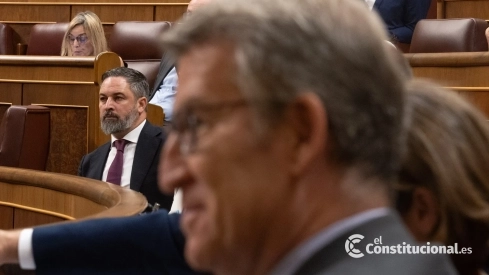
On the eve of 8M, International Women's Day, the debate on feminism has once again pitted the Popular Party and Vox against each other. While the PP defends that equality between men and women is a basic principle of democracy, the far-right party accuses the Government of using feminism for political purposes.
The deputy secretary of Education and Equality of the PP, Jaime de los Santos, affirmed this Saturday that those who deny feminism do so because they do not truly understand its meaning. In an interview on the program Parlamento of Radio Nacional de España, the popular leader maintained that any force that considers itself democratic should also assume feminism as part of its principles.
Her statements come in response to criticism from Vox and, in particular, from the party leader Pepa Millán, who accused the Executive of Pedro Sánchez "of the suffering of many women" as feminism, according to Vox, "a big business that has also harmed men, whom it has criminalized from the beginning because of all these gender laws." From the ultra party they maintain that, despite the millions allocated to the Ministry of Equality and to various public bodies, the figures for assaults and murders of women have not been reduced.
The Vox spokesperson also linked, once again, the increase in insecurity with what she described as “mass immigration”, assuring that it comes from cultures where, according to her argument, women are not respected. Asked if the denial of gender violence can deter victims from reporting, Millán defended that the real problem lies in what she describes as “ideological laws” promoted by a Government that, in her opinion, has contributed to women feeling more insecure today.
From the PP, De los Santos insisted that equality is a fundamental value that must be protected and prevented from becoming a political weapon. In his view, turning feminism into a partisan battlefield does not help progress. "If Vox denies feminism it is because it does not know what it is," he affirmed.
The popular leader added that feminism places women at the center, but also directly challenges men, whom it considers co-responsible in the construction of a more egalitarian society.
Add ElConstitucional.es as a preferred Google source for free.
Stay informed about all the latest breaking news with the best information. Against disinformation, for democracy and social rights.
