
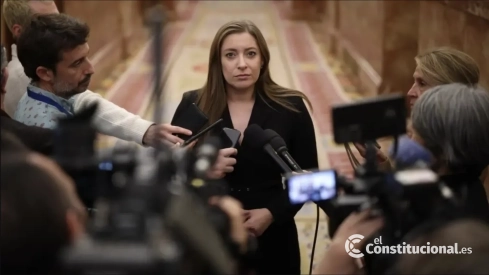
This is a response to Ester Muñoz, spokesperson for the People's Party in Congress, who in recent weeks has become one of the main critics of the headlines and approaches of this newspaper, ElConstitucional.es. She does not like our headlines or our editorial line. And, frankly, I do not regret it. When a journalist bothers a political party —be it the PP, the Spanish Socialist Workers' Party, VOX...— it means that they are fulfilling their duty of scrutinizing political power.
In short, this is a response to Ester Muñoz's publicly certified "conviction": the PP's willingness to make a deal with Vox. We published a headline to that effect and her own statements confirm it. The Popular Party maintains its willingness to reach agreements with Vox in autonomous communities and, by extension, also at the national level.
Meanwhile, Alberto Núñez Feijóo insists that he wants to govern alone, without integrating Vox into the Government. However, the same party that defends that position at the national level maintains at the regional level the conviction of reaching an agreement with Vox. And reaching agreements, given that party's demands, often implies its entry into governments.
The PP must clarify its position with Vox once and for all
Therefore, the first thing we ask for is coherence: governments with Vox or without Vox? Stable pacts or occasional support? It is necessary for the Popular Party to clarify its position. We journalists are not the only ones asking for this; citizens also deserve it.
Secondly, when one speaks of "stopping the far-right," that should be a democratic conviction, not a rhetorical formula. Curbing far-right populism should be a firm commitment for any democrat, whether right-wing or left-wing. In today's Spain, the party representing that current is Vox. It is therefore difficult to understand the PP's change in stance: from trying to avoid its dependence by seeking agreements with the PSOE to now naturally assuming pacts with Vox.
The PSOE must stop being inconsistent in 'stopping the far-right'
Now then, that demand for coherence must also be directed at the PSOE, at Pedro Sánchez's party. Defending the need to curb the far-right is a legitimate approach, but it must be translated into actions. In autonomous communities where the PP could govern without Vox with socialist abstention—as happened in Extremadura with María Guardiola—the PSOE rejected that possibility, alleging that it is not their responsibility to resolve the PP's internal problems.
It is true: the strategy of the Popular Party is its responsibility. But so is the institutional impact of regional governments depending on the far-right. If the objective is to curb their influence, perhaps it is time to debate specific agreements between the two major parties of Spanish democracy, even if there are profound differences between Feijóo and Pedro Sánchez. Setting them aside in certain contexts could prevent governability from being conditioned by the far-right.
In summary, the PP must be demanded clarity and coherence regarding Vox. And the PSOE, coherence between its discourse of stopping the far-right and its decisions when it has the possibility to do so.
