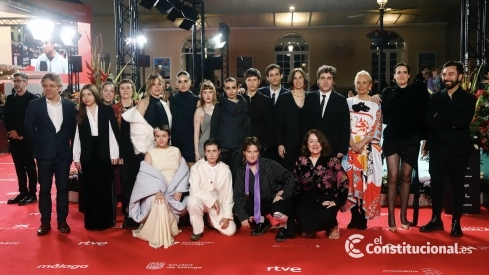
The director Marta Díaz de Lope Díaz presented this Sunday at the Málaga Festival her new feature film ‘Pioneers’, a film inspired by real events about the first Spanish female footballers who dared to play in the 70s despite the criticism, censorship and social opposition of the time.
The film, produced by RTVE, which competes in the Official Section of the competition, rescues an forgotten part of the history of Spanish sport and pays tribute to those women who defied social norms to defend their passion for football in a context in which their participation was still a cause for mockery or even prohibition.
At the presentation press conference, Díaz de Lope Díaz explained that Pioneers not only narrates the desire to play, but also the courage involved in fighting for a basic right: that of occupying a space that was denied to them. “The story of these players speaks of courage, passion, and freedom. They not only wanted to play football, but to show that they had the right to do so”, affirmed the director.
On the red carpet we were able to speak with Daniel Ibáñez, who was very grateful for the "magnificent reception" the film was receiving at the festival and for the pride of being this March 8th alongside the film's "great cast" and having been able to work with the director. "It is a film made by and for women and of course of the responsibility as a man to cooperate and be allies on such an important day and always". He considered that the influence of this type of films on the social and current conversation about feminism is "vital". "It is a luminous film, very far from bitterness and very close to kindness and empathy, and I believe that as men we have to be aware of the privilege we hold to be able to modify behaviors, cooperate and always be where we need to be, and for me the luck is to be able to be where I have to be".
The film traces the trajectory of a group of young people who defy the prejudices of the era and institutional obstacles to form the first women's football teams in Spain, thus opening the way for future generations. “Today we see full stadiums and girls who dream of being footballers, but there was a time when that seemed impossible. This film is to remember where we come from,” added the director.
During the script's development, written alongside Zebina Guerra, the director consulted testimonies and archive documents that allowed her to reconstruct in detail the social and cultural context of those years, including television programs, images of charity matches, and cinematographic references that helped illustrate the environment in which these pioneers emerged.
With a mix of emotion, humor, and a vindicative spirit, Pioneers proposes a cinematic journey towards the origins of women's football in Spain and pays tribute to the women who, with determination and courage, managed to change the history of the sport.