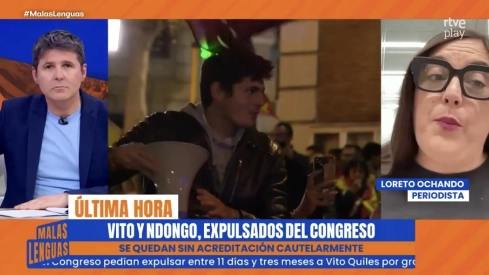
The controversy over the precautionary withdrawal of the accreditations of Vito Quiles and Bertrand Ndongo in the Congress of Deputies continues to grow. During a television appearance, the journalist Loreto Ochando, editor of El Plural, explained that the president of the Congress Bureau has applied a precautionary measure of 15 days while both are within the period for appeals for the sanctions that could remove them from the Chamber for up to three months.
Ochando compared the maneuver to “a full-fledged Boris Kasparov” and explained that the Bureau has invoked the Common Administrative Procedure Law of Public Administrations to prevent them from accessing the next plenary session while the file is being resolved. The journalist assured that the decision responds to the difficulties generated by these profiles within parliamentary activity and criticized the stance of the Popular Party for not supporting the withdrawal of accreditations. “That the PP is exposed is an obvious fact”, she affirmed, adding that “it is indecent” that the popular party members do not support measures to protect the work of accredited journalists.
In the same debate, the journalist Javier Díaz Aroca intervened, who defended that freedom of expression “also has constitutional limits” and pointed out that this type of behavior affects democratic coexistence within the Congress. Aroca also criticized the political support that, according to him, these communicators receive from conservative and far-right sectors, insisting that the problem is not only their presence, but “that they are being supported by the Popular Party”.
🔴 "As of now, neither Vito Quiles nor Ndongo can enter Congress."
— Malas Lenguas (@MalasLenguas_Tv) May 13, 2026
💢 "The Popular Party's stance on this is indecent. They have exposed themselves."@loretoochando, in #MalasLenguas pic.twitter.com/xwnnmSZeN0