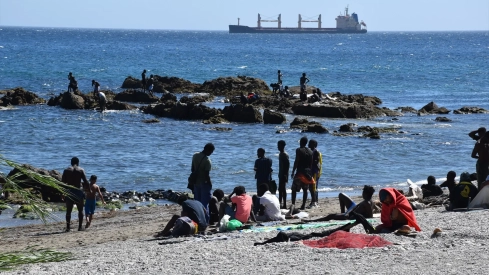
The Moroccan Association for Human Rights has raised to 141 the number of deaths in the massive entry registered a week ago at the borders of Ceuta and Melilla. The new balance expands the initial estimate of 130 victims and once again exposes the enormous differences between the data collected by humanitarian organizations and the figures released by Morocco.
The AMDH, the country's main independent human rights organization, has presented its first report on what happened together with the European Coordinator for Human Rights in Morocco. The count combines official information, data from morgues, testimonies from its observers, and figures provided by other entities working on the ground.
The definitive dimension of the tragedy remains open. The Institute of Legal Medicine counts 82 bodies recovered on the Spanish side, while the Government Delegation had previously placed the balance at 75. Morocco has updated its data this Friday and now recognizes 14 dead and 236 injured in its territory, three more deaths than those admitted last Sunday.
The figure released by NGOs remains much higher. Many victims remain unidentified, and numerous families continue to search for young people who disappeared after an entry in which some 72,000 people participated, mostly Moroccan citizens. The Ministry of Interior estimates that around 70,000 subsequently returned to Morocco.
A balance that still doesn't add up
The head of the AMDH in Tetouan, Achraf Mimoune, explained that the organization has located 21 bodies in the morgue of that city, 11 Moroccans and another 10 foreign nationals. Activists are also trying to verify the presence of another 17 bodies in the Tangier morgue.
The complete balance incorporates other data gathered in hospitals, forensic depots, and humanitarian organizations. The AMDH continues to cross-reference this information with the bodies recovered by Spain and admits that it is still impossible to offer a closed list with the identity and nationality of all victims.
In Ceuta, forensic and police teams have received reinforcements to speed up identifications. Most of the bodies will have to be buried soon in the autonomous city while DNA samples are preserved to allow for later comparison with those provided by relatives.
Morocco's new official count has raised the death toll to 14 and the injured to 236. Among the latter are 149 civilians and 87 members of the security forces. The Moroccan National Council for Human Rights has also acknowledged damage to dozens of vehicles and attributed part of the mobilization to calls disseminated by Facebook groups with over a million members.
The AMDH believes that these explanations omit the social causes that pushed tens of thousands of young people to risk their lives. Its president, Souad Brahma, has stated that what happened reflects a "deep social and political crisis" marked by unemployment, poverty, the absence of expectations, and the loss of trust in institutions.
The organization also denounces that the returns were carried out without adequate attention on the Moroccan side. Its observers affirm that many young people returned without finding medical personnel, guidance services, or public officials capable of informing their families.
Morocco's response has quickly extended to the courts. The National Council for Human Rights speaks of around a hundred detainees in the Ceuta area, with 69 people in pre-trial detention, in addition to another 23 arrested in Nador for attempts to enter Melilla. The AMDH expands the number of people preventively imprisoned for events linked to the entire crisis to 111.
Among those prosecuted are numerous minors. In Tetouan, 51 people were arrested, five of them minors, while in Nador another 52 were counted, including 18 minors. Seven taxi drivers have already received their first sentences, with penalties of up to six months in prison for having transported people towards the border.
Brahma has accused Morocco of acting as "Europe's gendarme" and of concentrating its response on security and judicial persecution. The AMDH demands an independent, complete, and transparent investigation to determine how the massive entry occurred, what happened during the returns, and how many people actually lost their lives.
Unidentified minors and another call on social media
The most urgent situation in Ceuta continues to revolve around the children and adolescents who arrived alone. The Government has registered 1,342 minors as of this Friday, although the Minister of Youth and Childhood, Sira Rego, acknowledges that many still remain unidentified.
The number has increased rapidly in recent days. Neighborhood entities and social organizations are touring streets, peripheral neighborhoods, and mountain areas to locate minors who sleep in the open or remain hidden for fear of being returned. Priority has been placed on children under 13 and those in a situation of greater vulnerability.
The AMDH estimates that around 3,500 young Moroccans still remain in Ceuta, an estimate that includes adults and unregistered minors. The organization warns that many are in inhumane conditions and that their integrity is at risk while they seek accommodation, food, or information about their situation.
Youth and Childhood expects to begin the first reallocations to the Peninsula within a few weeks. A technical team from the Ministry will be permanently installed in Ceuta starting August 16, and next week a meeting will be held with the autonomous communities to accelerate the procedure.
The Attorney General, Teresa Peramato, issued specific guidelines this Friday to guarantee the protection of minors. Prosecutors must intervene when a community refuses to receive them or delays their reception, demand adequate resources, and report any possible non-compliance with the obligations established by law.
The Popular Party assures that its regional governments will comply with the law, although it has accused the Prosecutor's Office of coming to the aid of the Executive. The far-right Vox maintains a different position and demands the immediate return of minors to Morocco. It also maintains that the coalition governments it shares with the PP will oppose the reallocations.
The protection of children requires studying each case individually. Some parents have requested the return of their children from Morocco, while other minors have expressed their willingness to remain in Spain. Any reunification must verify the family bond and respect the best interests of the minor.
Pedro Sánchez presided over a telematic coordination meeting this Friday with the Ministers of Defense, Interior, Migrations, and Youth and Childhood. The Government has also announced that Margarita Robles, Félix Bolaños, Fernando Grande-Marlaska, and José Manuel Albares will appear in Congress on August 25, 27, and 28 to explain the management of the crisis.
The authorities also maintain surveillance on social media. Calls continue to circulate to attempt a new massive entry next August 15. The Moroccan Royal Gendarmerie intercepted seven minors from Casablanca and Rabat during the early hours of the morning as they were traveling north of the country. The border remains reinforced while families continue to await the identification of the dead and missing.
Add ElConstitucional.es as a preferred Google source for free.
Stay informed about all the latest breaking news with the best information. Against disinformation, for democracy and social rights.
