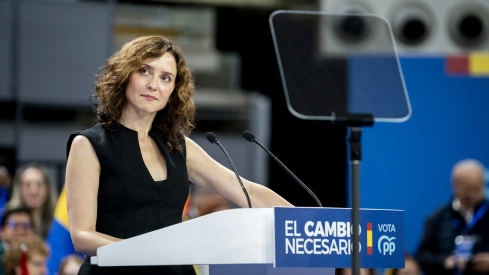
The Central Electoral Board (JEC) has decided to open disciplinary proceedings against the president of the Community of Madrid, Isabel Díaz Ayuso, for an institutional statement she disseminated on November 3, after the eviction of the housing encampment installed in Puerta del Sol. The body considers that her words, in which she held the President of the Government, Pedro Sánchez, responsible for what happened during the protest, could have violated the Organic Law of the General Electoral Regime (LOREG).
The decision represents a setback for Ayuso and sides with the PSOE, which appealed the agreement adopted on November 10 by the Electoral Board of Madrid. The Central Electoral Board has upheld the socialists' allegations and has revoked the previous criterion, considering that the statements recorded by the president and disseminated through the official channels of the Community of Madrid "could have been contrary to article 50.2 of the Organic Law of the General Electoral Regime". This precept establishes limits on the activity of public administrations during electoral processes. Specifically, it prohibits public authorities from organizing or financing events in which management achievements are boasted about or expressions and images coinciding with the campaigns of the parties running in the elections are used.
The opening of the proceedings does not mean that Ayuso has been declared responsible for an infraction or that she has to pay a fine yet. It is the beginning of a disciplinary procedure in which the facts and the possible responsibilities of the Madrid president will be analyzed.
Ayuso lashes out at Sánchez after the eviction of the Sol encampment
The controversy dates back to November 3, when the National Police and the Municipal Police evicted the encampment for the right to housing that had been installed for 38 days in Puerta del Sol. The protest had begun on September 26, after the eviction of a woman, and for more than a month gathered hundreds of people demanding solutions to the housing crisis. The eviction took place at dawn and ended with 334 people evicted and two arrested for resisting authority. The Government Delegation defended the intervention as a measure of last resort, after a process of gradual action and in view of the incidents recorded during the previous weeks.
After the police operation, Ayuso issued an institutional statement in which she directly attacked Pedro Sánchez and the actions of the Government Delegation in Madrid. The president assured that the head of the Executive had allowed the situation to drag on for more than a month and attributed to him responsibility for the damages and incidents recorded in the square. "Pedro Sánchez has once again allowed an illegal situation that has occurred in Madrid for 38 days," she stated at the beginning of her speech. She also maintained that "Sánchez consented for political interest to the illegal occupation of Puerta del Sol."
In her statement, Ayuso went further and held the President of the Government and the then government delegate in Madrid responsible for what happened: "Sánchez and his delegate in Madrid, until a week ago, are guilty, responsible for the kidnapping of this public place, for the violent acts that have been carried out during all these days, 38 days, in this square and throughout the area." The Madrid leader also linked the encampment to the economic losses of businesses in the area and estimated the damages at more than 30 million euros. Furthermore, she described what happened as "the legacy left by Sanchismo" and summarized her assessment with a series of terms: "Illegality, chaos, abandonment, dirt, violence, and misery."
Finally, she announced that her Government would continue to demand accountability through legal channels: "From the Community of Madrid, we will continue to demand through legal channels that those responsible for these acts, for this absence of compliance with the law, pay for all the damage they have caused."
The JEC focuses on institutional neutrality during the electoral campaign
Article 50.2 of the LOREG is the central point of the resolution. The rule establishes that, from the call for elections until their celebration, public administrations must maintain institutional neutrality and cannot use acts financed with public resources to highlight their management achievements or introduce messages that coincide with those used by political parties in campaign.
The purpose of this limitation is to prevent institution leaders from using public means and resources to favor a particular political position during an electoral process. It does not mean that public officials are prohibited from expressing their opinions or reporting on their activity, but rather that they must do so without using institutional acts as tools for electoral propaganda. In this case, the JEC considers that Ayuso's words may have violated that obligation by including direct criticism of the President of the Government in an institutional statement disseminated through the official channels of the Community of Madrid. For this reason, it has upheld the PSOE's appeal and ordered that the sanctioning procedure be processed.
The decision comes in the midst of the general election campaign on November 29, officially called on October 6. Electoral regulations affect all public administrations, regardless of which party governs, and require them to maintain a neutral institutional position during the process.
It is not the first time that the activity of political leaders during this campaign has ended up before the Electoral Board. The body has already examined other complaints related to interventions and videos disseminated from public institutions, both from the central government and from other political officials. The resolution on Ayuso once again places at the center of the debate the limits between the freedom of expression of leaders and the duty of neutrality that they must respect when acting as institutional representatives.
Contact
We are listening. Get in touch.
