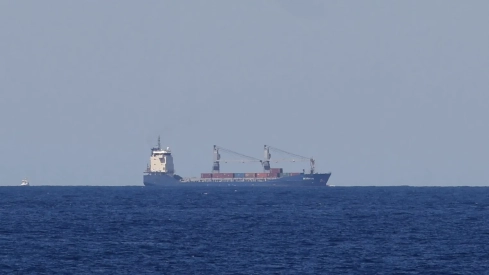
An investigation released by the 'CNN' network has placed the Russian freighter Ursa Major at the center of a possible episode of espionage and international tension. The vessel, sunk off the coast of Murcia on December 23, 2024, would have transported alleged nuclear components destined for North Korea, according to several sources cited by the American network.
The freighter, 142 meters long and belonging to the Russian state company Oboronlogistics, was officially sailing from Saint Petersburg to Vladivostok with a declared cargo of cranes, containers, and large metal structures. However, the investigation maintains that the ship's true final destination was the North Korean port of Rason, where it was supposedly to deliver components related to nuclear reactors for submarines.
According to sources from the Spanish investigation cited by 'CNN', the ship's captain, Igor Anisimov, would have subsequently admitted that two alleged “well covers” included in the manifest were actually pieces similar to those used in nuclear reactors for submarines. Although the captain himself assured that they did not contain nuclear fuel, experts believe that they could be biological shields linked to atomic propulsion systems.
The investigation also casts doubt on the official version of the sinking. While Spanish authorities initially pointed to an explosion in the engine room, different sources maintain that the ship could have been hit by torpedoes or limpet mines. The report even mentions the possibility of a Western military operation aimed at preventing Russia from transferring advanced nuclear technology to the Kim Jong-un regime.
Hours before the sinking, the Spanish maritime rescue service mobilized a helicopter, a tugboat, and a fast vessel after receiving a distress call from the freighter. Witnesses present in the area observed how the vessel reduced speed and began to list while part of the crew abandoned the ship. Subsequently, the sailors reported that three explosions had occurred on board.
The case became even more enigmatic days after the shipwreck. According to 'CNN', the Russian ship Yantar, pointed out on several occasions for espionage activities, remained for five days over the remains of the Ursa Major before new underwater explosions were detected in the area. In parallel, the United States would have sent a specialized aircraft to track possible radiation remains in the air.
North Korea recently presented the hull of what it assures will be its first nuclear-powered submarine, a strategic technology that would significantly strengthen its military capability in Asia. The sinking of the Russian freighter also occurred shortly after Pyongyang increased its cooperation with Moscow in the context of the war in Ukraine.
