The forest fire in Vall d'Uixó has regained strength in recent hours and remains out of control on its fifth day. The fire has already devastated some 9,300 hectares, reaches a perimeter of 81 kilometers, and keeps around 10,000 people evacuated in the interior of the Sierra de Espadán.
The main concern is concentrated on the western flank, between Tales and Alfondeguilla, where the steep terrain, ravines, and dense forest make access difficult for the teams. The flames also keep several sectors active near Eslida, Alcudia de Veo, and Artana.
The fire suffered several flare-ups on Tuesday afternoon, causing sudden advances of between 500 and 800 hectares. The thermal inversion trapped smoke over the affected area and prevented aerial means from intervening until 5:00 p.m. in some of the most problematic spots.
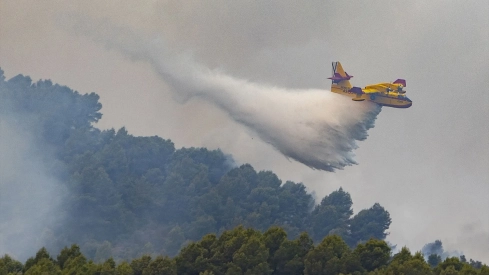
Conditions have partially improved this Wednesday, and planes and helicopters have been able to join since early morning. The scarce presence of wind facilitates the work, although atmospheric stability may again concentrate smoke and limit air operations.
Fernando Kindelán, director of the Advanced Command Post, has described a situation marked by "very complicated" orography, broken areas, and extremely dense vegetation. The teams are trying to consolidate the still active fronts and await the arrival of the flames in accessible places where they can attack them with water lines and other extinguishing maneuvers.
Towns prepare for new evacuations
Several municipalities in Castellón have asked their residents to prepare an emergency backpack with documentation, medications, water, clothes, chargers, and essential items in the event of new evacuations. The fire continues to approach inhabited areas, and the heatwave increases the risk of new outbreaks.
Concern has grown especially among the elderly and those suffering from respiratory diseases. Residents of the threatened municipalities report that the smoke makes breathing difficult, and some assure that much of the information reaches them through the media while they await new official instructions.
Aín, Alcudia de Veo, Alfondeguilla, Artana, Tales, Eslida, Sueras, Villamalur, Torralba del Pinar, Ayódar, Fuentes de Ayódar, Chóvar, Azuébar, and Almedíjar remain evacuated, as well as the hamlet of Artesa, belonging to Onda. Accesses remain closed to prevent residents from returning while the emergency continues.
The evolution has allowed some restrictions to be eased in areas far from the most dangerous fronts. La Vilavella has completely lifted the confinement, although its inhabitants must consume bottled water for 72 hours. In Betxí and Onda, several urbanizations remain confined or evacuated, including Nueva Onda, Solaig, Montserrat, and Peña Negra.
Authorities maintain 310 occupied places in shelters in Segorbe, Onda, Nules, and Moncofa. Another 172 people are being transferred to the Universitat Jaume I student residence, the Penyeta Roja high-performance center, and the La Vilavella spa so they can rest in rooms after four nights away from their homes.
The Civil Guard will reinforce surveillance of the evacuated municipalities during the afternoon with agents from the Valencia Reserve and Security Group. So far, no robberies or looting have been reported, but the operation will maintain patrols to protect homes and provide peace of mind to their owners.
Escorts to feed animals or attend to farms remain suspended in areas without safe access. Urgent cases are managed through the town councils and the Advanced Command Post, which must authorize each entry.
The fire has also altered judicial activity. The High Court of Justice of the Valencian Community has extended the special measures adopted due to the emergency for July 30 and 31. Affected persons may communicate their inability to attend a summons, and non-appearances will be justified, while judicial bodies may suspend hearings, proceedings, and procedural deadlines.
More than 1,200 professionals facing the flames
More than 1,200 professionals are assigned to extinction, with around 400 personnel working simultaneously in shifts. The operation brings together forest firefighters from the Generalitat, provincial consortiums, the Military Emergency Unit, Civil Guard, Generalitat Police, health personnel, and resources from the Ministry for Ecological Transition.
Since early morning, ground and heliborne units, fire engines, forest brigades, and crews from Valencia, Alicante, Catalonia, and Aragon have been deployed. The forecast includes the progressive incorporation of more than 30 aerial assets during the day if smoke accumulation allows flights to be maintained.
Des de primera hora d'este matí estàn treballant a l' #IFLaVallDUixó els següents mitjans:
— Emergències 112CV (@GVA112) July 29, 2026
➡️15 Unitats terrestres, 3 unitats helitransportades i voluntaris de la Vallesa de @GVAbforestals
➡️ 16 autobombes
➡️ 32 dotacions, 4 Brigades forestals y 4 Brigades rurales d’actuacions…
Night work allowed some sectors to be consolidated through technical fire and direct attack. The more than 600 ground personnel concentrated their efforts in Alfondeguilla, Eslida, and the axis formed by Tales and Alcudia de Veo, before the incorporation of the first aerial assets.
Se trabaja en todo el perímetro del #IFLaVallDUixó , centrándose actualmente los esfuerzo en los sectores de Alfondeguilla, Eslida y Tales-Alcudia de Veo.
— Bombers Dipcas (@BombersDipcas) July 29, 2026
Durante la noche los trabajos han sido positivos, con uso de fuego técnico y ataque directo. Desde primera hora ya se han… pic.twitter.com/3IfCsu9QBd
The Military Emergency Unit has increased its presence and the total resources provided by the State exceed 435 personnel. The operation is working on a particularly difficult surface, with steep slopes and ravines that force them to await the advance of the fire from safe positions.
The fourth heatwave of the summer began this Wednesday with rising temperatures and a very high or extreme risk of fire in much of the country. Emergency officials rule out being able to declare the fire stabilized during this day and warn that there are still broken fronts with areas of flame.
A scar visible from space
The magnitude of the fire can be seen from space. Images taken by the European Sentinel-2 satellite on July 28 at 10:58 AM show the enormous smoke plume and the extent of the burned surface over the province of Castellón.
The false-color composition allows distinguishing preserved vegetation in green tones, burned areas in dark, reddish, and brown colors, and hotter spots in intense red. At the time of capture, the most active fronts were concentrated in the north of the fire and were advancing mainly towards the north and west.
The sequence allows tracking the path of the flames through the municipalities of Vall d'Uixó, La Vilavella, Betxí, Artana, and Eslida. The affected area directly crosses the natural environment of the Sierra de Espadán, one of the most valuable forest areas with the most complex orography in the Valencian Community.
Satellite observation facilitates the identification of devastated areas and the general evolution of the fire. Decisions on evacuations, access, and deployment of resources depend on data provided from the ground and the operational direction of the emergency.
The burned area also includes orchards, irrigation systems, warehouses, and agricultural exploitations. AVA-Asaja has demanded extraordinary aid and fiscal measures for affected producers, especially for those who cultivate citrus, avocados, vineyards, olive trees, and almond trees, whose recovery may take several years. The agricultural organization has also asked the Júcar Hydrographic Confederation for greater cleaning of ravines and riverbeds. According to their version, the accumulation of reeds and undergrowth would have facilitated the flames reaching some plots, a claim that will have to be evaluated when the complete spread of the fire can be studied.
The emergency coincides with the debate opened by the latest Valencian budgets. The Consell of Juanfran Pérez Llorca and Vox have approved a 10% reduction in investment allocated to preventing forest fires, equivalent to 10.7 million euros. The budget for the General Directorate of Fire Prevention goes from 118 to 107 million.
The Generalitat attributes the decrease to the end of extraordinary actions financed to repair infrastructure damaged by the DANA and assures that it maintains the reinforcement of preventive surveillance, firebreaks, and water reservoirs. The Environmental Education budget is also halved, while planned material investments increase from nine to 21 million.
The teams face the coming hours pending the rise in temperatures and a possible new thermal inversion. The operation will continue securing the perimeter, attacking hot spots, and waiting for the flames in the accessible areas of the west flank, where the fire still retains the capacity to continue advancing.
Add ElConstitucional.es as a preferred Google source for free.
Stay informed about all the latest breaking news with the best information. Against disinformation, for democracy and social rights.
