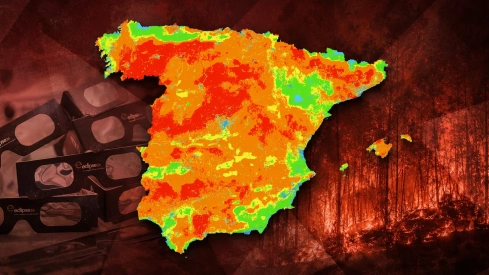
Spain prepares to witness this Wednesday, August 12, a historic total solar eclipse on one of the most delicate days of summer for the mountains. AEMET forecasts a very high or extreme risk of forest fires in a large part of the Peninsula and the Balearic Islands, with temperatures that will once again exceed 40 degrees in some areas.
The astronomical phenomenon will arrive in the late afternoon, when millions of people will travel to viewpoints, mountain ranges, and rural areas to find a clear horizon. This concentration coincides with very dry vegetation, intense heat, and favorable conditions for any fire to advance rapidly and be difficult to control.
The eclipse, by itself, lacks the capacity to cause a fire. The added danger comes from the human activity that will surround it. A vehicle parked on dry grass, a cigarette butt, a stove, pyrotechnic material, or a blocked access can turn a trip to the countryside into a large-scale emergency.
AEMET updated its special forecast this Monday and issued a direct warning to those planning to travel. "A fire that starts will be very difficult to control," warned the Agency, which will publish new revisions before the eclipse begins.
🌘 ACTUALIZACIÓN PREDICCIÓN ESPECIAL | Eclipse solar del 12 de agosto.
— AEMET (@AEMET_Esp) August 10, 2026
➡️ Calor intenso y peligro de incendios muy alto o extremo. ¡Precaución!
➡️ Algunas nubes en zonas del norte y este peninsular y en el norte de Canarias.
Info completa👉https://t.co/Tr0X82td2I pic.twitter.com/riRgeKEX89
A map dominated by very high and extreme danger
The Forest Fire Danger Index will reach very high or extreme levels on Wednesday in a large part of the Peninsula and the Balearic Islands. The main exceptions appear in some areas of northern Galicia, the Cantabrian area, the eastern Pyrenees, the middle course of the Ebro, eastern Andalusia, and the peninsular southeast, where moderate or high levels will predominate.
In the Canary Islands, a generally moderate danger is expected, although there will be areas with high or very high values. The situation will not end with the eclipse either. AEMET forecasts that during Thursday and Friday, the areas subject to the highest categories will continue to increase, especially in Galicia, the Cantabrian region, the peninsular southeast, and the Canary archipelago.
The map has been prepared with the new index launched this year by AEMET. The system combines temperature, humidity, wind, and accumulated rainfall with information on the state of vegetation, soil moisture, and type of surface. Its resolution reaches one kilometer, allowing for more detailed detection of areas where fire could behave with greater virulence.
Temperature will contribute to raising the danger. Maximums will exceed 35 degrees in most of the peninsular interior and the Balearic Islands, with slightly milder values in northern Galicia, the Cantabrian Sea, coastal areas, and mountainous regions. The Guadalquivir and Ebro valleys could exceed 40 degrees, a mark that could also be reached more locally in other southwestern valleys.
At the time of the eclipse, temperatures will have dropped between two and five degrees compared to the day's maximum values. The typical late afternoon drop will slightly alleviate the heat, but vegetation will continue to present especially dangerous dry conditions.
The sky will be mostly clear or clear in much of the country. Low clouds could hinder observation in northern Galicia, the Cantabrian area, and the Alboran coast. Evolution clouds will also grow in northern mountains, the eastern third, and some areas of eastern Andalusia, with possible isolated storms in the eastern Pyrenees, the Teruel Iberian System, eastern Castilla-La Mancha, and the Betic Systems.
Up to 2.9 million displacements
Interior estimates that the eclipse could generate between 1.8 and 2.9 million displacements towards the more than 350 observation points identified within the totality band. This band will cross Galicia, Asturias, Cantabria, Basque Country, Navarra, La Rioja, Castilla y León, Madrid, Castilla-La Mancha, Aragón, Catalonia, Comunitat Valenciana, and the Balearic Islands.
The state apparatus has also established 123 exclusion zones where access will be limited or prohibited due to their environmental fragility, difficulty in evacuating them, or lack of adequate roads for emergency services access.
More than 33,600 agents of the National Police and Civil Guard will participate in the operation. The greatest burden will fall on the Civil Guard, with more than 24,200 personnel due to the rural nature of many observation sites. Nearly 2,500 agents will be specifically dedicated to traffic tasks.
Protección Civil has activated the pre-emergency phase in Operational Situation 1 and has installed a Unified Command Post at the National Emergency Center. From there, crowds, mobility, communications, forest fires, and possible health problems caused by heat or inadequate observation of the Sun will be monitored.
Authorities ask to avoid improvised displacements and go to official points, prepared to maintain evacuation routes, parking lots, and access for ambulances, firefighters, and forest teams. The DGT also demands that no driver stop on the shoulder to observe the phenomenon.
Aragon toughens prohibitions and Galicia bans 29 places
The communities with the highest influx have adopted different measures depending on the danger and characteristics of each territory. Some affect the entire autonomous community and others are concentrated in parks, mountains, or especially sensitive roads.
Aragon maintains the most severe restrictions from this Monday until Thursday, August 13. It is forbidden to light fires even in recreational areas, rest areas, and enabled camping spaces, as well as to use pyrotechnic material in the mountains or within a 400-meter radius.
Access to the mountains with motor vehicles is also prohibited, except for entering private properties, accommodations, hospitality establishments, enabled parking lots, or urban centers, in addition to professional activities and emergency services. Infractions may entail fines of between 1,001 and 100,000 euros.
Camping will be limited to the official points of Javalambre, Épila, Calamocha, and Alcañiz-MotorLand, along with the authorized local spaces in Ariza and Cariñena. The community has also classified any party or mass gathering lacking authorization as a prohibited spectacle.
In Galicia, a provisional list of 29 exclusion zones has been drawn up that do not meet adequate access, mobility, or evacuation conditions. Eight are in A Coruña, 17 in Lugo, one in Ourense, and three in Pontevedra.
Among the affected places are the Tower of Hercules and the islands of San Pedro, Monte Pindo, Carnota beach, Fuciño do Porco, Roncadoiro lighthouse, Papel cliffs, Fervenza do Toxa, and Monte da Guía de Vigo. Against these exclusions, the Xunta has recognized dozens of official points distributed throughout the four provinces.
Castilla y León has marked on a map the areas to which it advises against traveling, especially those belonging to the Network of Protected Natural Areas. The Junta asks to avoid unpaved, one-way or dead-end forest roads, where a vehicle could get trapped if a fire were to break out.
It will also be forbidden to park on roads, rural paths and forest tracks, as well as to camp outside expressly authorized places. The community coincides with one of the weeks that historically concentrates more forest fires, while numerous towns in Soria, Burgos, León, Palencia, Segovia and Valladolid await a massive arrival of visitors.
The Comunitat Valenciana will activate pre-emergency level 3 throughout its territory. The measure prevents lighting fires in forest areas and their surroundings, suspends authorizations for sports tests and activities in these areas and will mean the closure of natural parks.
The Generalitat will reinforce surveillance through preventive flights and will keep 26 aerial means available. It has also enabled observation points in urban spaces or prepared to receive the public, with the intention of moving concentrations away from the most vulnerable forest areas.
Madrid asks to restrict the mountains and the Balearic Islands limit their access
In Madrid, the Government Delegation has asked the Community this Monday to restrict pedestrian and vehicle access to the Sierra de Guadarrama National Park and the Cuenca Alta del Manzanares Regional Park. The request still needs to be translated into a formal decision by the regional Executive.
The region has 67 official points distributed among 66 municipalities. In the ports of Cotos and Navacerrada, traffic will be cut off when the parking lots are full, following a system similar to that used during major snow episodes. Residents, workers and emergency services will be able to maintain access.
Tres Cantos has already suspended live music, workshops, food stalls and the rest of the activities it had programmed in the Valdeloshielos estate. The City Council has also prohibited the entry of vehicles to protect this space and the surroundings of El Pardo mountain.
The Balearic Islands will limit vehicle access to about twenty roads leading to natural areas, lighthouses, beaches, and viewpoints. Restrictions will generally operate between 3:00 PM and 9:00 PM, although they may be brought forward or extended if parking lots fill up or traffic problems arise.
The Government has enabled 26 official observation zones on the islands and has reinforced the protection of the Serra de Tramuntana and other especially sensitive areas. Residents, workers, accommodation clients, and public services will be able to pass through some of the controls provided they prove the need for access.
The danger has also forced the cancellation of large gatherings. The Vinuesa City Council, in Soria, revoked the authorization for the 'Iberia Eclipse' festival, which expected to gather nearly 1,500 people. In Huesca, the 'Sizigia' macro-festival, planned for 10,000 attendees next to the Sotonera reservoir, will also not be held.
How to avoid a fire during observation
Civil Protection asks people to go to the countryside without stoves, barbecues, candles, generators, or any device capable of producing a flame or a spark. Cigarette butts should not be thrown, glass bottles should not be left behind, and pyrotechnics should not be used.
Vehicles must be parked only in designated areas and on clear surfaces. Contact of the exhaust system with dry vegetation can start a fire, while parking on shoulders, roads, or tracks can block the entry of firefighting teams and the exit of those present at the location.
The safest option is to observe the eclipse from home, from one's own municipality, or from one of the official points. Those who travel must consult the restrictions of their community and city council before leaving, carry water and heat protection, and use approved eclipse glasses conforming to ISO 12312-2 standard.
AEMET will update the forecast again before Wednesday. If smoke appears or a flame is detected during observation, the instruction is to immediately call 112, move to a clear area, and keep all accesses clear for emergency services.
