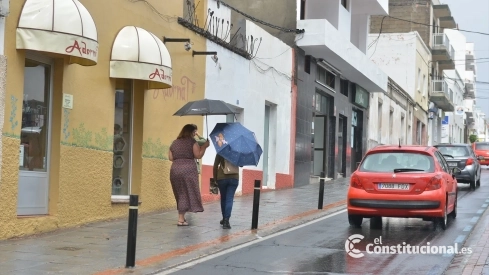
The stability of these last days has an expiration date. After several days of calm in a good part of the country, with clear skies and rising temperatures, the weather is preparing to change with the arrival of storm Therese, an Atlantic system that will once again bring rain, wind and a more unstable environment.
During this Tuesday, the situation will remain generally calm in the Peninsula and Balearic Islands, with a predominance of high pressures and only some low clouds in areas of the north and the Mediterranean. But this scenario is just a parenthesis. The State Meteorological Agency (Aemet) has already focused on the change that will arrive starting Wednesday.
🌀 Our Portuguese colleagues from @ipma_pt have named the storm Therese.
— AEMET (@AEMET_Esp) March 16, 2026
➡️ The Canary Islands will be the most affected area of Spain, with locally heavy rains, storms, intense winds and rough seas starting Wednesday 18.
[1/2] pic.twitter.com/WiFD0C0Mx0
The Canary Islands will be the first affected area
The Canary Islands will be the first territory to clearly notice the effects of the storm. The archipelago will fully receive the impact of Therese, with rainfall that could be locally intense, in addition to storms, strong wind gusts, and a notable worsening of the sea state.
The islands with higher relief will be the most affected, where significant accumulations in a short time are not ruled out. Added to this is that the storm will tend to remain relatively stationary for several hours, which will favor the associated fronts discharging continuously. In that context, episodes of persistent showers are expected that could be accompanied by a storm and even hail sporadically.
The change will arrive progressively to the Peninsula
In the Peninsula, the change will be more progressive, although also evident. The approach of Therese from the Atlantic will begin to be noticed with an increase in cloudiness, especially in the southwestern peninsula.
Western Andalusia and the Strait area will be some of the first areas where isolated showers or occasional storms could be registered. With the advance of the week, these bands of medium and high clouds could extend towards other areas of the western third, leaving a more unstable environment than that of previous days.
In this initial phase, precipitations will be more irregular than in the Canary Islands, although the trend points to a change towards a wetter pattern.
A season of storms that breaks records
The arrival of Therese also occurs in an unusual context. This storm is the 19th of the 2025-2026 season, a figure that breaks all records since the naming system began in 2017, when the maximum had been set at 17.
This increase reflects a particularly active season in the Atlantic, with successive storms that have been affecting both the Peninsula and the Canary Islands' surroundings in recent months. Aemet itself does not rule out that, if the official list of names is exhausted, an additional list agreed upon among the countries involved will be activated.
Drop in temperatures and wind as protagonists
The change in weather will also be noticed in temperatures. Before the arrival of the storm, maximums have experienced a notable rise in some areas of the north and interior, with increases that have exceeded six degrees in areas such as the eastern Cantabrian or the Iberian System. This rebound will be halted with the entry of more humid and unstable air.
The wind will be another of the prominent elements. In the Canary Islands, gusts could reach strong intensity, while in the peninsular south, episodes of easterly wind have already been recorded in the vicinity of the Strait and Cádiz, with values that have exceeded 70 kilometers per hour.
End of stability
The passage of storm Therese puts an end to the episode of stability of recent days and opens the door to more variable weather in several areas of the country.
