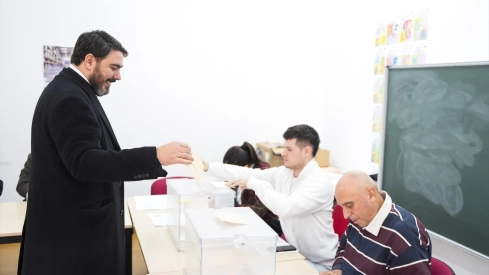
You have the wrong ballot, you have put two in the envelope or you have written something unintentionally. What happens if you make a mistake when voting in the general elections on 29N? The key is the moment: as long as the envelope is not in the ballot box, it can be fixed. Once inside, the vote can no longer be changed, and depending on the error, it can count as valid or as void.
If you realize before voting
If you have not yet handed in the envelope at the table, simply take another ballot and another envelope. At the polling station there are ballots from all candidacies and plenty of envelopes. It is best to leave or discard mistaken ballots out of sight of other voters to maintain the secrecy of the vote. If in doubt, ask the members of the table: they are there to help you.
If you have already put the envelope in the ballot box
There is no turning back. The vote deposited in the ballot box is final and cannot be recovered or repeated: each elector can only vote once. What happens to it will depend on the nature of the error.
The most common errors and what happens to the vote
Two ballots from the same party in the envelope
The vote is valid and counts as a single vote for that party.
Two ballots from different parties in the envelope
The vote is void, because it is not possible to know who the elector intended to vote for.
The empty envelope
It is a blank vote, which is valid and counts towards calculating the 3% threshold. Differences between blank vote, void vote, and abstention.
Ballot with scribbles, names or messages
In Congress, a ballot with alterations, strike-throughs or annotations may be declared void. Do not write anything on it.
Torn ballot or from other elections
Ballots that are not the official model for these elections, for example from previous elections, are void. If a ballot is slightly torn but the candidacy is clearly identified, the table decides on its validity.
The Congress ballot in the Senate envelope (or vice versa)
Each election has its ballot and its envelope: white for Congress and sepia for the Senate. Mixing them is a frequent error and can cause the vote not to be counted. Check carefully before handing them in.
Errors when voting for the Senate
On the sepia Senate ballot, the chosen candidates are marked with a cross: up to three in peninsular provinces. You can mark fewer, even just one, and the vote is valid. If you mark more than allowed, the vote is void. A Senate ballot without any crosses is considered a blank vote. How to vote for the Senate.
How to avoid errors
- Prepare your vote calmly in the booth.
- Check that each ballot goes in its envelope: white for Congress, sepia for the Senate.
- Put only one ballot in each envelope.
- Do not write or mark anything on the Congress ballot.
- Bring the original document: DNI, passport or driving license.
Who decides if a vote is null?
The polling station, during the scrutiny that begins at 8:00 PM. Party representatives can protest if they disagree, and those ballots are attached to the minutes for the Electoral Board to review in the general scrutiny on December 4.
📌 Guide to the 29N elections
🗳️ To vote today
- Until what time can you vote today?
- Can you vote with an expired DNI?
- How to vote for the Senate: the sepia ballot
- Blank vote, null vote and abstention
- Polling station: what happens if you don't go
📊 Election night
- What time are the results known?
- Exit polls: what time do they come out
- Where to see the results by municipality
- Participation: times and evolution
- Candidates and parties of 29N
🏛️ After 29N
Contact
We are listening. Get in touch.
