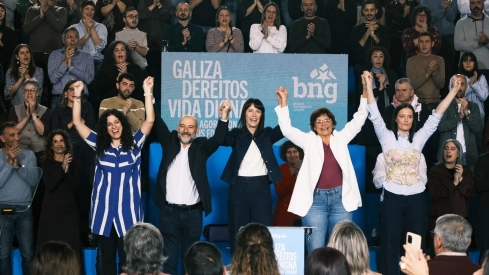
The Galician Nationalist Bloc (BNG) was born in September 1982 as a political project that aimed to bring together the different organizations and currents of Galician nationalism. However, its construction was not without internal tensions. The Unión do Povo Galego (UPG), a Marxist-Leninist ideology party, played a fundamental role in the creation of the front and became one of the main centers of power within the organization during its early years.
This is stated in the study "The BNG: definition and evolution of its organizational structure", prepared by José Vilas Nogueira and Manuel Ángel Fernández Baz and published in 2004 in the Revista de Estudios Políticos of the Center for Political and Constitutional Studies (CEPC). The research analyzes the first twenty years of Galician nationalism's trajectory and explains how the BNG went from being an organization that grouped different parties and collectives to acquiring its own political structure.
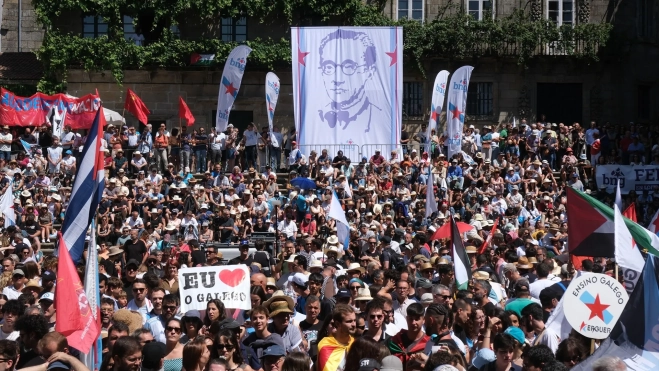
The founding of the BNG took place in a context of territorial reorganization of the State after the approval of the Statute of Autonomy of Galicia. The new institutional framework opened opportunities for nationalist organizations to have a greater political presence and representation in regional institutions. In September 1982, its Constituent Assembly was held, in which different parties, collectives, and independents participated. Among the organizations that promoted the project, the UPG and the Galician Socialist Party (PSG) stood out, although the latter formally left the front in January 1983.
The UPG, the main driving force of the BNG during its early years
The research highlights that the Unión do Povo Galego was decisive in the initial construction of the Bloque Nacionalista Galego. Its organizational capacity, the internal cohesion of its militants, and its greater territorial presence allowed it to acquire a predominant position over the other organizations that participated in the project. The authors explain that the UPG provided a good part of the resources necessary to launch the BNG. It also inherited infrastructures from the Galician National Popular Assembly (ANPG), such as premises and media, in addition to contributing to organizing the presence of the new front in different localities and regions.
During the first years, the influence of the UPG was not limited to organizational issues. According to the study, it also played a prominent role in defining political strategy and decision-making. The BNG's bodies ended up formalizing decisions, but a large part of the agenda was initially established within the UPG itself.
This situation began to change progressively as the BNG gained greater electoral and institutional relevance. The organization gained autonomy from the parties that comprised it and strengthened its own governing bodies.
The BNG's shift towards institutions and internal changes
One of the episodes that marked the evolution of the BNG occurred in December 1985. Until then, the organization maintained a position of opposition to the Constitution and the Statute of Autonomy. However, in an extraordinary assembly, it decided that its public officials would accept the oath of both texts to access their institutional responsibilities.
The decision caused internal tensions, especially within the UPG, where different positions coexisted regarding the strategy that Galician nationalism should follow. One part advocated a more pragmatic stance favorable to institutional participation, while another sector refused to accept the Constitution and the Statute. The latter would end up leaving the UPG and forming the Communist Party of National Liberation in 1986. Another important moment came in 1989, when the BNG decided to present a candidate for the Presidency of the Xunta de Galicia. This decision consolidated its commitment to participate in institutions and compete electorally, without abandoning social mobilization.
During the nineties, electoral growth and the incorporation of new organizations favored a transformation of its structure. The BNG gained greater autonomy, progressively centralizing its governing bodies and reducing the weight of the organizations that had initially promoted it. The X National Assembly, held in April 2002, was another step in this process. Among the approved changes were the replacement of the Permanent Committee with a National Executive and the modification of the representation of the parties and groups integrated into the front.
In their conclusions, the researchers argue that the BNG went from functioning as a front of organizations with a primarily assembly-based structure to becoming a more centralized and institutionalized political organization. A process in which the UPG played a decisive role during its first years of existence.
Contact
We are listening. Get in touch.
