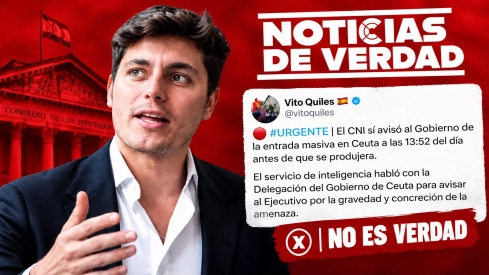
The political news is once again marked by the migratory crisis in Ceuta and the publication of documents that allow us to know what information the Spanish authorities handled during the days prior to the entry of more than 70,000 people into Spanish territory. The new episode of Noticias de Verdad, the podcast of ElConstitucional.es with Hugo Pereira, director of this media, and Clara Cerrada, deputy director of the same, analyzes the keys to the declassified documentation and the political and judicial consequences of what happened.
One of the main focuses is on the warnings prior to the crisis. The documents published by the Government confirm that the CNI informed the Government Delegation in Ceuta on July 29 of the existence of a call disseminated through social networks to try to access the autonomous city both by sea and by the fence the next day.
The intelligence service also identified two groups that totaled 180,000 followers, although the documentation specifies that this figure referred to the potential reach of the dissemination and not to an estimate of the people who would participate in the attempted entry.
The documentation also reveals that the CNI contacted the Guardia Civil and transferred information about attempts to access by swimming and by jumping the fence. In addition, it sent an urgent note to its Moroccan counterparts regarding the planned calls during the Feast of the Throne.
Could the massive entry have been avoided?
The episode thus analyzes one of the main unknowns left by the documentation: if the existing warnings allowed anticipating a crisis of such magnitude and if the authorities acted sufficiently in the face of the signals that were already on the table.
The Government maintains that the intelligence services could not foresee the dimension that the crisis would subsequently reach. The CNI itself recognizes that it did not anticipate either the magnitude or the nature of the massive entry.
However, the documents show that there were previous warnings about calls to attempt to access Ceuta. The expression "mass entries", moreover, appears in a document from the National Police and not in the CNI message that referred to the 180,000 followers. The National Immigration and Borders Center (CENIF) warned of communications in migrant groups to organize entries combining land and swimming access, going so far as to qualify the risk of a coordinated action by both routes as "EXTREME".
The podcast addresses the differences between the information handled by the CNI and the National Police and analyzes to what extent one can speak of a lack of foresight, coordination, or reaction on the part of the Government.
The 141 deceased and María Tardón's investigation
Another aspect addressed in the episode is the human cost of the crisis. The mass entry into Ceuta caused the death of 141 people who tried to access Spanish territory, a tragedy that is also part of the judicial investigation opened into what happened.
The case is being investigated by the National Court judge María Tardón, and the podcast analyzes whether the publication of the documents can provide new elements to the investigation and whether the actions of the Spanish authorities during the previous days may end up being part of the judicial focus.
Morocco and the reaction during the Feast of the Throne
The documents also provide information about the role of Morocco. The declassified documentation does not provide evidence that the Moroccan Government was behind the organization of the entry, in line with what the Spanish Executive has been defending.
However, the CNI does point to a "lack of proactive reaction" and a "late reaction" on the part of the Moroccan security forces. The organizers also intended to take advantage of the celebration of the Feast of the Throne, a circumstance that, according to information provided by the CNI, could affect the Moroccan security apparatus.
The opposition charges against the Government after the publication of the documents
The publication of the reports has also provoked an immediate reaction from opposition parties. The Popular Party, through Borja Sémper, stated that "the Government has published documents that undermine its arguments," while Vox has demanded that Article 102 of the Constitution be activated to demand accountability from the Prime Minister, Pedro Sánchez, for an alleged crime of treason.
Sumar, for its part, has questioned the Executive's actions and believes that the Government should have made more efforts to prevent the crisis. The episode thus analyzes to what extent the declassified documents can politically compromise the Government and whether the differences between the Executive's parties and its partners can end up affecting its parliamentary stability.
Vito Quiles and the disinformation about the CNI warnings
The episode also focuses on the controversy that arose on social media after Vito Quiles and other right-wing and far-right accounts spread that the CNI had warned the Government of a "massive entry" on July 29.
The documents, however, show a different reality. The CNI warned of a call to attempt to enter by sea and over the fence, identified the groups in which it was being disseminated, and indicated the planned date. But it did not use the expression "massive entry" nor did it estimate that tens of thousands of people would participate.
The 180,000 followers mentioned in the message also do not represent an attendance forecast: the CNI itself used that figure to explain the reach of the dissemination of the call. The expression "massive entries" does appear in the documentation, but it corresponds to a National Police alert, specifically from CENIF.
The new episode of Noticias de Verdad analyzes all these elements with Hugo Pereira, placing documents and data at the center of the debate to separate the warnings that actually existed from the political interpretations that have been made subsequently.
Add ElConstitucional.es as a preferred Google source for free.
Stay informed about all the latest breaking news with the best information. Against disinformation, for democracy and social rights.
