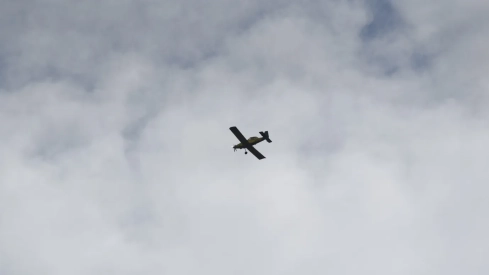
Spain has requested help from the European Union to combat the fires that continue out of control in the southwest of the Community of Madrid and the province of Ávila. The European Commission has responded with the dispatch of four Canadair planes, two from Greece and two others from Italy, which will reinforce extinction efforts.
The request was made on Thursday night through the European Civil Protection Mechanism. The General Secretariat for Civil Protection and Emergencies processed the request at the behest of the Military Emergency Unit (UME), the Armed Forces body specialized in intervening in major catastrophes, to have at least four fixed-wing aerial assets.
The decision came after the Ministry of Interior declared the emergency of national interest due to the fires in Villa del Prado and San Martín de Valdeiglesias, in Madrid, and Burgohondo, in Ávila. It is the first time that Spain activates the highest level of the National Civil Protection System for a forest fire.
Level 3 places the direction of the emergency under the authority of the Minister of Interior, Fernando Grande-Marlaska, and leaves the operational command in the hands of the head of the UME. The State Coordination and Direction Committee, known as CECOD, brings together the Government and the affected communities to organize resources and maintain a common strategy.
🤔¿Situación Operativa 3? 🚨 Es el máximo nivel de respuesta ante emergencias:
— Ministerio del Interior (@interiorgob) July 24, 2026
▪️El Comité Estatal de Coordinación y Dirección, que reúne a Estado central y CCAA, coordina la estrategia.
▪️@interiorgob encomienda el mando operativo a @UMEgob.
▪️Se movilizan FCSE, @DGTes, @dsn... pic.twitter.com/3iqokmB9NU
Four European planes and more than 1,900 state personnel
The two Canadair offered by Greece and the other two provided by Italy have already been mobilized by Brussels. The European Union has also made available to the operation the images from the Copernicus satellite service, used to delimit the affected area and monitor the advance of the fronts.
The Spanish deployment includes 1,100 UME personnel and 225 ground vehicles. Added to these are 650 Civil Guard agents, 60 vehicles, two helicopters, and two advanced command posts, in addition to 110 Civil Protection personnel.
The Ministry for Ecological Transition has sent 78 professionals, including three Forest Fire Reinforcement Brigades, along with eight planes, six helicopters, and a mobile analysis and planning unit. The operation also includes regional resources, firefighters, forest agents, and personnel displaced from Andalusia and Extremadura.
Estos son los medios del Gobierno de España desplegados hoy en los incendios de la Comunidad de Madrid y la provincia de Ávila.
— La Moncloa (@desdelamoncloa) July 24, 2026
La coordinación entre todos los cuerpos y unidades del Estado es clave para hacer frente a unos incendios que siguen activos.
Mucha precaución. pic.twitter.com/NLiWetMtbH
The magnitude of the operation reflects a situation that remains critical. The fires have devastated around 6,000 hectares in Madrid and more than 9,000 in Ávila, while nearly 25,000 people have had to leave their homes.
The fires of Almorox and San Martín de Valdeiglesias have merged, forming a large front in western Madrid. Efforts are now focused on preventing the flames from reaching the Burgohondo fire. Fresnedillas de la Oliva, Robledo de Chavela, Chapinería, Navas del Rey, and Colmenar del Arroyo are among the latest evacuated municipalities, while Navalagamella remains confined.
How the European aid, also requested by France, works
The European Civil Protection Mechanism allows a country to request assistance when a disaster exceeds or threatens to exceed its available resources. Assistance must be requested by the affected State and is channeled through the Emergency Response Coordination Centre, based in Brussels and operational 24 hours a day.
Participating countries offer planes, helicopters, fire brigades, rescue teams, medical supplies, or specialized personnel. The European Commission coordinates the proposals, helps finance the deployment, and organizes the arrival of the resources accepted by the requesting country.
When national offers are insufficient, Brussels can resort to rescEU, its strategic reserve for major emergencies. The 2026 campaign has 22 firefighting planes and five helicopters stationed in twelve countries, in addition to 777 firefighters pre-positioned in the European areas with the highest risk.
La situation reste sous très forte tension face aux incendies qui frappent le pays, en particulier en Gironde.
— Emmanuel Macron (@EmmanuelMacron) July 23, 2026
Mes pensées vont à nos sapeurs-pompiers et aux forces de secours qui luttent sans relâche sur le front des flammes. Leur courage force le respect.…
France has resorted this Friday to the same mechanism given the advance of several fires in the southwest of the country. Emmanuel Macron has announced the arrival of two Canadair from Croatia, two Air Tractor from Portugal, and two Black Hawk heavy helicopters provided by Czechia and Slovakia.
French authorities have ordered the complete evacuation of the Cap Ferret peninsula, on the Atlantic coast, where the fire had ravaged at least 8,700 hectares. Another fire near Biscarrosse had burned about 2,500 hectares and forced the evacuation of more than 23,000 people.
Spain has already accumulated 114,796 hectares of forest burned since January, almost five times more than during the same period in 2025. The Ministry for Ecological Transition counts 29 large fires, 17 of them registered only during July.
France is around 60,000 affected hectares and also largely exceeds its usual average. Both countries have had to resort to European support while heat, dry vegetation, and wind multiply the propagation capacity of fires that are putting national devices under maximum pressure.
Add ElConstitucional.es as a preferred Google source for free.
Stay informed about all the latest breaking news with the best information. Against disinformation, for democracy and social rights.
