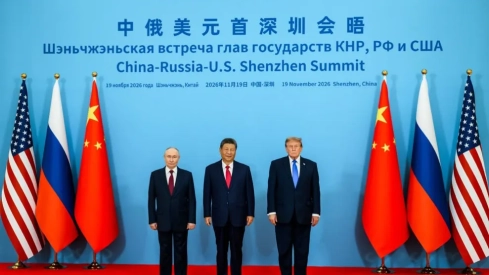
Donald Trump, Xi Jinping, and Vladimir Putin held this Thursday in Shenzhen the first trilateral summit in history and the meeting ended without concrete measures on Iran or Ukraine.
The presidents of the United States, China, and Russia met for approximately an hour and a half, on the sidelines of the APEC summit, and concluded the meeting with a four-point declaration focused on UN reform, the increase in the production and supply of petroleum derivatives, the prevention of nuclear weapons proliferation, and the immunity of heads of state.
The meeting, which did not produce operational announcements on the two open wars weighing on the event, also left an explicit demand that the International Criminal Court "not abuse" its powers.
The historic photo does not translate into commitments on open conflicts
Trump opened the conversation with a message of closing to confrontation. "Too often, past leaders avoided speaking with nations with which they had disagreements," he said, before insisting that dialogue is the only way to resolve crises, although the meeting did not leave decisions on the ground.
The President of the United States also criticized the International Criminal Court, which he called "out of control," according to Reuters. His offensive against the court, which is investigating the genocide in Gaza and has requested Putin's arrest, did not, however, translate into an immediate reform or a formal change in its powers.
Putin, for his part, linked the meeting to the post-war architecture and assured that the three countries share the responsibility of maintaining international peace and security. He recalled that their States were "the victors of the Second World War" and defended preserving and strengthening the system of international law.
Peace through strength. pic.twitter.com/LPxLLC998v
— The White House (@WhiteHouse) November 19, 2026
The nuclear table advances, but without deadlines or disarmament agreement
Xi Jinping placed the center of the conversation on the nuclear threat and called for "all efforts" to prevent such a war, according to the official Chinese agency Xinhua. He added that the solution involves the "total prohibition and comprehensive destruction" of these weapons, although the final declaration did not set deadlines. Trump admitted that the three countries are in a "privileged position" to discuss the reduction of arsenals, but added that "it is not easy" to give them up. The issue remains open after the expiration this year of the New START treaty.
Before the three-way summit, Trump held a meeting of about 40 minutes with Putin, whom he called "my friend." Afterwards, he also met with Xi, whom he praised for having received him at the foot of the runway, a gesture he had not repeated with any other leader since he assumed the presidency. In that bilateral meeting, Trump spoke of a "very special" relationship with the Chinese leader and mentioned areas of cooperation such as the fentanyl crisis. He also stated that he sought to help put an end to the war between Russia and Ukraine, although that reference was not later materialized in the trilateral meeting.
Xi had previously received Putin and described the ties between China and Russia as "as firm as a mountain in the midst of wind and rain." In parallel, Marco Rubio, United States Secretary of State, joined the meeting between Trump and Putin, while the Polish Prime Minister, Donald Tusk, reacted on X with a warning: "God, save us from such friends."
After the meeting, the most delicate part of the agenda remains pending: how and when nuclear arsenals will be discussed and whether the powers will convert the political declaration of Shenzhen into a real negotiation process.
Contact