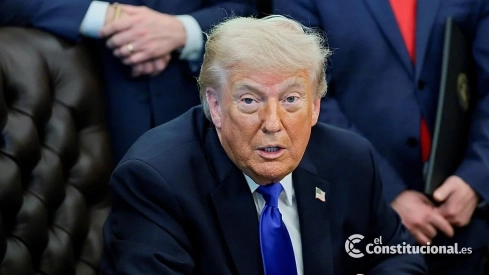
The US Secretary of State, Marco Rubio, assured this Saturday that Washington has achieved “important” advances in the last 48 hours together with its Gulf allies to unblock the situation in the Strait of Hormuz and channel an agreement with Iran. From New Delhi, Rubio avoided giving concrete details, although he hinted that President Donald Trump could soon announce a principle of understanding with Tehran.
According to the head of US diplomacy, the immediate objective is to guarantee a “completely open” Strait of Hormuz and free of restrictions for international maritime traffic. Rubio also insisted that the United States continues to bet on a diplomatic solution and warned that the military option remains on the table if negotiations fail. “I would prefer this problem to be resolved by the State Department and not the War Department,” he stated.
In parallel, Pakistan's Prime Minister, Shehbaz Sharif, confirmed that Islamabad expects to host “very soon” a new round of talks between Washington and Tehran. The Pakistani government has consolidated itself as one of the main mediators in the conflict and assures that there are “significant advances” to close a pact that allows reducing regional tension.
For its part, the Iranian agency 'Tasnim' has revealed some details of the draft being negotiated by both parties. The document would include the end of hostilities on all fronts and a temporary suspension of sanctions on Iranian oil while talks last. In addition, it is contemplated to recover within 30 days the usual volume of ships that crossed the Strait of Hormuz before the start of the war.
However, one of the main points of friction, the Iranian nuclear program, would have been left out of this first agreement. According to the 'Fars' agency, issues related to nuclear reserves and atomic facilities would be addressed in a second 60-day negotiating phase. In this way, Iran would avoid assuming commitments for now on the dismantling of its nuclear capacity, one of Washington's main demands in recent months.
