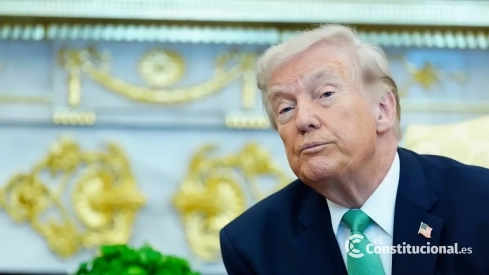
The president of the United States, Donald Trump, rejected this Sunday the response sent by Iran to the peace proposal promoted by Washington to try to end the war. “I have just read the response from the so-called representatives of Iran. I don't like it, Totally unacceptable!”, Trump wrote on his social network 'Truth Social'. The US Administration expected to receive this weekend a formal response from Tehran to decide whether to maintain the truce initiated last April 8 or if it resumed hostilities given the lack of progress regarding the Iranian uranium enrichment program.
The Iranian response, partially disseminated by state media and picked up by the semi-official agency 'Tasnim', demanded several conditions from Washington to move towards a definitive ceasefire. Among them, guarantees that there would be no new military attacks, the lifting of US economic sanctions, the end of the ban on the sale of Iranian oil, and the elimination of the naval blockade in the Strait of Hormuz. Furthermore, Tehran demanded economic compensation for the damages caused during the war and defended its sovereignty over Hormuz, a strategic maritime route through which approximately a fifth of the world's oil and liquefied natural gas circulated before the conflict.
The Iranian Government also linked any agreement to the end of the fighting in Líbano, where Israel maintains clashes with the Shiite militia Hizbulá, backed by Tehran. Meanwhile, Pakistán, which acts as a mediator between both parties, confirmed having officially received the Iranian response. The Pakistani Prime Minister, Shehbaz Sharif, explained in a speech in Islamabad that the head of the Army, Field Marshal Asim Munir, informed him of the reception of the document, although he avoided detailing its exact content so as not to compromise the still open diplomatic negotiations.
The political and military escalation has had an immediate impact on international markets. After Trump's rejection became known, the price of oil rose more than four dollars per barrel amid fears that the conflict would prolong and keep maritime traffic through the Strait of Hormuz practically paralyzed. Data from Kpler and LSEG platforms also showed that several oil tankers left the area with tracking systems turned off to reduce the risk of suffering attacks. Phillip Nova market analyst, Priyanka Sachdeva, summarized the situation by stating that “the oil market continues to behave like a geopolitical headline reaction machine”, with strong price fluctuations after each diplomatic move between Washington and Tehran.
In parallel, military tensions continue to spread across the region. Emiratos Árabes Unidos asserted having intercepted two drones coming from Irán, while Qatar denounced an attack against a cargo ship in its territorial waters. For its part, Kuwait reported the neutralization of several hostile drones that penetrated its airspace. Added to this are the ongoing clashes in south of Líbano between Israel and Hizbulá, despite the ceasefire announced in April with US mediation. The Israeli prime minister, Benjamin Netanyahu, stated in an interview on CBS News that “there is work left to do” to eliminate Iranian enriched uranium and dismantle its military capability.
Trump also insisted that, although Iran is “defeated,” that “does not mean they are finished,” and threatened new attacks against Iranian “targets” if negotiations fail. For his part, the Iranian president, Masud Pezeshkian, responded through social media that his country “will never bow to the enemy” and will defend “its national interests with firmness”. The conflict also begins to have internal political consequences in the United States, where polls show growing citizen rejection of the war due to the increase in gasoline prices and the fear of an energy crisis a few months before the legislative elections. Furthermore, several NATO allies have refused to send military vessels to the Strait of Hormuz without a clear international mandate and a more solid peace agreement.
Add ElConstitucional.es as a preferred Google source for free.
Stay informed about all the latest breaking news with the best information. Against disinformation, for democracy and social rights.
