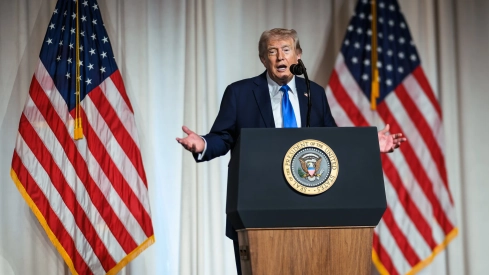
Donald Trump has needed less than 24 hours to dismantle one of his latest decisions on the war against Iran. The President of the United States has withdrawn the 20% fee he intended to charge on goods transported through the Strait of Hormuz and has announced that he will replace it with trade agreements and investments from Gulf countries in US territory.
The shift only affects the toll. Trump maintains the blockade against ships entering or leaving Iranian ports and against those transporting goods related to the Islamic Republic. The military offensive launched by Washington also continues, which has seen three nights of bombings against Iranian facilities.
"After very productive conversations with Middle Eastern leaders, I have decided to replace the 20% reimbursement fee with trade and investment agreements," the president explained on Truth Social. Trump assures that the investments will be "enormous" and will generate millions of jobs, although he has not yet provided specific amounts, deadlines, or commitments assumed by the Gulf monarchies.
The rectification comes after calls received from Saudi Arabia, United Arab Emirates, Qatar, Bahrain, and Kuwait, countries closely linked to Washington and highly dependent on free circulation through Hormuz. The toll would have made their exports more expensive and also punished allies whose navigation the United States claimed to want to protect.
A fee that barely survived a day
Trump announced on Monday that the United States would become the "guardian of the Strait of Hormuz" and would charge 20% of the value of all goods transported through the area. He justified the measure as compensation for the costs and risks assumed by the US Armed Forces to keep this route open.
The proposal was born without an explanation of its application. The White House also did not clarify which authority would collect the money, how the value of each cargo would be calculated, or what would happen to ships that refused payment. A fee of that size could add tens of millions of dollars to the cost of a single large oil tanker.
The announcement also clashed with the position previously defended by the U.S. Administration itself. Washington had demanded for weeks that Iran renounce any toll and guarantee free transit through the strait. Secretary of State, Marco Rubio, had maintained that no country could charge for crossing an international maritime route.
The International Maritime Organization also rejected the plan and recalled that there is no legal basis to impose a mandatory payment for simple transit through an international strait. Fees can only be linked to specific services, such as port assistance, piloting, or towing.
Trump has now adopted that same position. During his meeting at the White House with Iraqi Prime Minister, Ali al-Zaidi, he stated that no one should charge for crossing Hormuz or any other strait. The president presented the investments promised by Arab countries as a more beneficial formula for all parties.
Energy markets received the change with some relief. Oil had climbed during the morning amid fears that the toll and blockade would worsen supply difficulties. Brent crude reached over 87 dollars before cutting some of its gains after the reversal was announced.
The blockade against Iran continues
The withdrawal of the toll reduces one of the sources of tension with U.S. allies, but leaves the siege against Tehran intact. Trump has proclaimed that Hormuz will remain open to all ships, except those linked to Iran, and has accused its leaders of leading the country towards "total destruction."
The blockade will begin to be applied at 10:00 PM this Tuesday in peninsular Spain. U.S. forces will try to prevent the passage of vessels coming from Iranian ports, destined for them, or transporting products associated with the Islamic Republic.
Washington has attacked Iranian coastal defense systems, missile and drone facilities, naval capabilities, and command centers for three consecutive nights. Central Command maintains that its objective is to reduce Tehran's capacity to threaten commercial ships.
Iran has responded with missiles and drones against US and allied positions. The operations have reached Bahrain, where the United States Navy's Fifth Fleet is located, and Jordan. Kuwait has also activated its defenses against an air attack.
The escalation has spread to civilian traffic. Three oil tankers were attacked in recent hours in the vicinity of Hormuz and Oman. The International Maritime Organization has reported two sailors killed and 14 injured in the aggressions against two vessels linked to the United Arab Emirates.
The European Union Aviation Safety Agency has also warned of the danger of flying over Bahrain, Kuwait, Qatar, the United Arab Emirates, and the Gulf of Oman due to the simultaneous use of missiles, drones, fighter jets, and anti-aircraft defense systems.
June truce unravels amid bombings
The new wave of attacks leaves the provisional agreement reached in June practically broken. That memorandum was supposed to guarantee safe and free passage through Hormuz for 60 days, while negotiators from both sides tried to finalize a definitive pact on navigation, sanctions, and the Iranian nuclear program.
The United States and Iran have interpreted the text differently from the beginning. Tehran believes the agreement recognized its ability to manage the strait, while Washington maintains that the waterway must remain open and free of any fees.
Trump has already informed Congress of the resumption of hostilities and maintains that he has the authority to continue the attacks without new parliamentary authorization. Both chambers had approved resolutions to limit another military offensive, although the White House questions their legal scope.
The president has also threatened to bomb Pickaxe Mountain, a mountain near the Natanz nuclear plant under which Iran is suspected of having built a complex of tunnels intended to protect nuclear facilities and material. Trump admits that the United States has not detected recent activity, but has assured that the enclave may be attacked soon.
Israel remains outside the latest direct exchanges for now. Benjamin Netanyahu has warned, however, that any Iranian offensive against its territory will receive a "much more forceful" response than previous ones.
The US blockade against Iran-related ships will come into effect tonight, as regional mediators try to restore the ceasefire before the attacks spread to other Persian Gulf countries.
