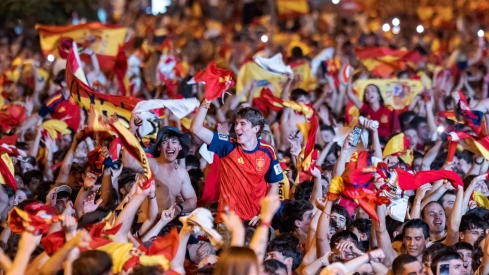
Madrid vibrated with Spain's second star and this time there is a record capable of measuring it. The seismic sensor of the Royal Observatory captured the jumps and celebrations of the fans during the decisive moments of the World Cup final that pitted La Roja against Argentina on Sunday night.
The National Geographic Institute shared this Monday the accelerogram collected between 11:00 PM and 1:00 AM. The graph allows following a good part of the match through the vibrations generated in the city, with perfectly recognizable peaks during the two disallowed goals, Ferran Torres' goal, the final whistle, and the subsequent trophy presentation.
⚽ ¡Así se registró anoche la emoción en Madrid! ✌️
— Instituto Geográfico Nacional-O.A.CNIG (@IGNSpain) July 20, 2026
📈 El sensor sísmico del Real Observatorio de Madrid ha registrado los momentos clave del partido Argentina-España que hicieron vibrar anoche a la ciudad de Madrid.
Se aprecia claramente en el acelerograma la actividad sísmica… pic.twitter.com/L9sDG2wxrD
"This is how the emotion in Madrid was registered last night," the organization explained. The accelerogram reflects the movements detected by the sensor during that period. The more people jumped, ran, or celebrated at the same time, the greater the agitation recorded on the ground.
The final whistle surpasses Ferran's goal
The first notable change appears around 11:27 PM, coinciding with one of the disallowed goals during the final. The line then returns to its usual level until, close to 11:44 PM, Ferran Torres' goal causes one of the biggest jumps of the entire night.
The forward decided the match during extra time and converted the play that would give Spain its second World Cup into a goal. The reaction was immediate in homes, bars, squares, and streets of the capital. The IGN record shows a sharp increase in amplitude and several intense movements during the subsequent minutes.
Another disallowed goal leaves a new mark shortly after, although the strongest moment was yet to come. The highest peak of the accelerogram coincides with the end of the match, just past midnight. The intensity clearly surpasses that recorded during the goal and remains high while the Spanish players begin to celebrate on the field.
The activity decreased afterwards, but grew again around 00:45. The new movement coincides with the delivery of the Cup and the moment in which the champions lifted the trophy, an image still followed by thousands of fans from Madrid.
A final that united Spain again
The Spanish national team won the World Cup after beating Argentina 1-0 in New York. The match needed extra time and was decided by Ferran Torres' goal that gave La Roja its second star, sixteen years after the title won in South Africa.
The victory unleashed celebrations throughout the country. In Madrid, thousands of people took to the streets during the early hours of the morning while institutions, players and fans shared the first images of a generation that is already part of the history of Spanish football.
The party will continue this Monday with the arrival of the national team in the capital. The champions will tour Madrid after institutional receptions and will close the day in Cibeles, where tens of thousands of people are expected to attend.
The record of the Royal Observatory offers another way of telling the final. Around 00:02, the blue line shot up above the rest of the night. Madrid had just heard the whistle that made Spain world champion for the second time.
