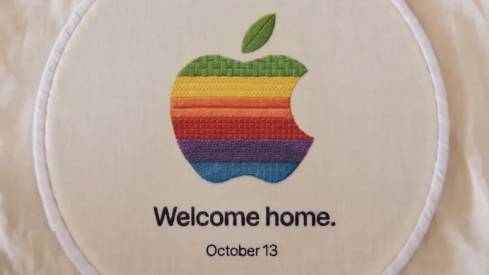
Apple is about to enter a new product category with a bet that could be decisive for its technological strategy. The company will hold an event this Tuesday, October 13, under the slogan Welcome Home, where it is expected to present HomeView, a smart display designed for the home that will allow users to interact with Siri and quickly and easily consult information.
The device would not only be a new addition to Apple's catalog. It would also test the company's ability to leverage advances in artificial intelligence and maintain its position against competitors like Google and OpenAI, who are working on new ways to interact with technology through assistants capable of understanding requests and executing actions.
Apple tries again with the connected home
The company has been trying for years to carve out a niche in the smart home market, although its previous proposals have not managed to achieve the expected prominence. In 2014, it presented HomeKit, a platform designed to connect different devices, and two years later, it launched the Home app to manage them. However, both initiatives had limited reception, partly due to compatibility restrictions and Siri's shortcomings.
Its bet on hardware has not quite taken off either. The HomePod arrived on the market in 2017, but was withdrawn in 2021 and later recovered in 2023. Since 2020, the company has also marketed the HomePod mini, a smaller and more economical alternative. Despite this, these speakers have struggled to compete with proposals from Google and Amazon, as well as with manufacturers specializing in sound like Sonos.
It could be like a small iPad
Leaks suggest that HomeView will have a design similar to a small iPad, with a square touch screen between six and seven inches. Apple would be preparing two versions: one designed to be placed on a table or countertop and another that can be installed on the wall. The first would have a speaker base and a metallic stand, while the second would have a flatter structure to integrate into the domestic space.
The desktop model could be marketed in four finishes: gray, silver, starlight white, and pink. The wall-mounted version would, according to leaked data, have a more limited range of colors. The device would also incorporate a front camera for video calls and to facilitate the identification of family members.
Inside, HomeView would feature an A18 chip and 8 GB of RAM, a configuration that would allow it to execute the planned artificial intelligence functions. It would not, therefore, be a simple speaker with a screen, but a device designed to manage different tasks and offer personalized information to the inhabitants of the house.
Siri, at the center of the new strategy
The possible launch of HomeView coincides with the renewal of Siri, the virtual assistant that Apple has tried to transform through new artificial intelligence functions. The company presented a revamped version during the summer and, according to information published by The Independent, the update arrived last month. The improvement of Siri would be one of the keys for the new home devices to offer a more complete experience.
Alongside HomeView, Apple is also preparing updated versions of the HomePod mini and Apple TV, with a greater role for the virtual assistant. Rumors suggest that these products had been ready for some time, but that their launch would have been postponed until the new Siri was ready. This reflects the importance of the assistant for the future of the company's home strategy.
The intention goes beyond improving voice responses. Apple wants Siri to be able to leverage the information available on each user's devices to help them organize their tasks and perform actions more directly. If this approach is confirmed, the assistant would play a central role in the daily relationship between people and their technological products.
The battle for artificial intelligence also threatens the iPhone
Apple's bet is part of a broader competition. Companies like OpenAI and Meta are exploring new devices that allow the use of artificial intelligence without continuously depending on the mobile phone. This vision proposes a change in the way of interacting with technology: instead of navigating through menus and applications, users could simply express what they need and let their assistants take care of executing it.
Apple, for its part, keeps the iPhone at the center of its strategy. The company argues that its current devices can become the main access point to artificial intelligence, complemented by new products such as smart glasses and home devices. Along the same lines, its new CEO, John Ternus, recently presented a vision of the phone as a smart personal hub capable of integrating processing, screen, sensors, and different AI functions.
Home products would fit into that ecosystem as extensions of the iPhone, with the aim of allowing Siri to be available in different spaces and situations. According to the information that has emerged, HomeView could connect to the phone to facilitate authentication and share data between devices.
A key launch for Apple's future
The success of this strategy will depend on Apple's ability to turn Siri into a truly useful tool and make its connected devices attractive compared to more economical and consolidated alternatives. The company needs to demonstrate that it can compete in both artificial intelligence and the smart home, two areas in which it has not yet achieved the same leadership it maintains with the iPhone.
HomeView could thus become an important piece of its next technological chapter. If Apple manages to integrate artificial intelligence into users' daily lives, it will reinforce the role of its ecosystem. If it fails to differentiate its proposal, rivals like Google and OpenAI could gain ground with products that aspire to change the way people use technology.