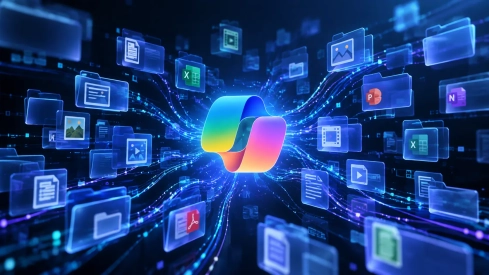
Microsoft wants artificial intelligence to stop being limited to answering questions and start doing more things directly on the computer. To do this, the company has presented its bet on hybrid intelligence, a system that combines models executed on the device itself with cloud services to expand the possibilities of Copilot in Windows.
Copilot will be able to work with files and automate tasks
Among the new planned capabilities are organizing files, helping diagnose computer problems, and executing certain actions within Windows. The intention is that the user can delegate some tasks to the assistant without having to manually follow each step.
This approach changes the relationship with the assistant: instead of copying information into a conversation and manually following instructions, the user will be able to delegate certain operations. However, the available functions will depend on the tool, the permissions granted, and the characteristics of the computer.
To make this possible, Microsoft will combine local processing with the cloud: operations that can be resolved on the computer will be executed there, while others will resort to remote services. This approach can reduce internet dependence for certain functions, although it does not mean that Copilot will work completely offline.
The new features will be rolled out progressively over the coming months, with a special focus on Copilot+ PC devices, designed to run artificial intelligence functions on the device itself.
More autonomy, but also security controls
To address this problem, Microsoft has presented its Microsoft Execution Containers (MXC), an isolation system designed to control the environment in which artificial intelligence agents work. The technology allows setting limits on the resources they can access and managing their actions in a more controlled way.
The objective is to reduce the risks associated with the execution of automated tasks, preventing an agent from having unlimited access to the system. This type of measure will be especially relevant as assistants move from offering recommendations to performing operations on behalf of the user. Even so, technical protections do not eliminate all risks. Security will also depend on the permissions granted, the device configuration, and the measures applied by each application.
Windows prepares for a new stage of artificial intelligence
With this strategy, Microsoft aims to turn Windows into a platform ready for assistants capable of intervening in daily work. The goal is no longer just for artificial intelligence to respond better, but for it to be able to perform useful tasks directly on the computer: to make the computer better understand what the user needs and help them complete tasks.
The company has also announced news related to new equipment and hardware oriented to artificial intelligence, in collaboration with Nvidia. This evolution reinforces its commitment to devices capable of executing more processes directly on the computer.
The rollout will be gradual, and not all new features will be available from the outset on all devices. However, the move anticipates a significant change in the role of digital assistants: the next battle of artificial intelligence will not only consist of responding better, but of doing more things within the computer itself.