An investigation into the underground economy that grows in the shadow of devotion. We delve into the black market of Holy Week that how faith moves, also, millions in cash.
Balconies that are worth more than a car, resold chairs in secret chats and police disguised as tourists.
The smell of incense arrives before the procession. First a murmur, then the silence, then the dull sound of the drums that makes the ground vibrate underfoot. Thousands of people hold their breath at the same time. It is one of those moments in which an entire city seems to stop.
But not everyone looks at the step.
If one looks closely, and one has to look very closely, one can see those who observe in another direction. The man talking on the phone too calmly on a corner. The woman typing something on her mobile from a balcony without barely looking down. The group of tourists guided by someone who knows every alley with a precision that no application provides. Behind the Holy Week that is seen, there is another that moves in silence, that does not issue invoices, that does not appear in any official report and that, nevertheless, moves an amount of money that no one has managed or wanted to fully quantify.
This is the story of that other Holy Week.
“The price is not negotiable”
The investigation begins, like so many other times, on the internet. Not on the official websites of the brotherhoods nor on the tourist portals of the city council. On the other sites: Facebook groups with ambiguous names, Telegram chats where access must be requested, classified ads that appear and disappear in a matter of hours.
The product that is sold there is no secret. They are balconies.
More concretely, it's the views from those balconies: a rectangle of sky over the Official Route, the privilege of seeing the procession without pushes, without barriers, without having to arrive four hours early to get a spot. In cities where Holy Week is big, and there are several in Spain where it is enormously so, that has a price. A price that no one puts in writing, that is negotiated by word of mouth and that is paid, almost always, in cash.
How much? Between 3,000 and 9,000 euros for the seven days. Some owners add catering. Others, an open bar. One of them, whom we contacted pretending to be interested, cuts us off abruptly when we try to haggle: “The price is not negotiable. If you don't want it, I have ten more waiting”. He hangs up before we can ask a second question.
Others are somewhat more talkative. They explain to us that there are families who have been reserving the same balcony for years, who pay in advance without seeing it, who consider that expense a tradition as unmovable as the procession itself. “There are people who book months in advance. They pay to see without crowds,” another owner tells us. Behind that phrase there is a reality that it does not state: none of those transactions go through a POS terminal. None apparently generate an invoice.
The question of how much of that money reaches the Treasury floats in the air. No one answers it.
Fertilizer as currency
We went down to the asphalt. If the balconies are the luxury, the chairs of the Official Route are the mass market. And also, in their own way, a small scandal in slow motion.
The chairs are administrative concessions. Their official price is around 100 euros. But in the same groups where balconies are sold, and in other more discreet ones, those chairs appear at 400, at 500, sometimes more. The mechanism is so simple that it is difficult to combat: the original holder transfers their subscription to a third party, the paper changes hands, and the next link in the chain pays up to five times the price set by the city council.
“It is impossible to control”, someone with years of experience in the sector admits to us. “The paper passes from hand to hand. Who is going to check who the original holder is in the middle of a procession?”
Nobody, it seems. And everyone knows it.
In the margins of this market also operate unlicensed tour guides, another figure that grows each year discreetly. They charge around 50 euros per person, promise shortcuts and privileged views and lead groups of foreigners, many of them with no idea of the local geography, through alternative routes that sometimes end in dead ends or in security restricted areas. They don't have insurance. They don't have authorization. They do have, however, a lot of smooth talk and a knowledge of the terrain that no official course provides.
Those who do not watch the procession
There is a third category of people who do not look at the step. And they are, perhaps, the most interesting.
They are there, mixed with the crowd. Some wear dark clothes that fit the atmosphere of recollection. Others go as tourists, with backpack and camera, although they don't photograph anything in particular. The most experienced call them, with a certain irony, the ‘invisible brotherhood’.
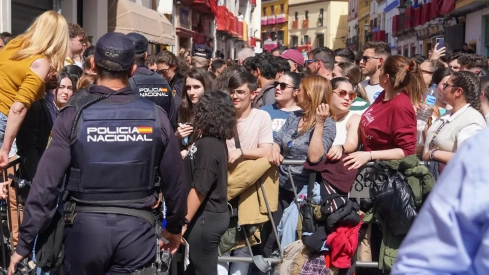
They are plainclothes agents, and their deployment during Holy Week is very important.
They are not just looking for the usual pickpocket, the one who takes advantage of the push and distraction of the solemn moment to empty a pocket. They are looking for patterns. They are looking for someone who has been looking at the same person for ten minutes. For someone who leaves a backpack on the ground and walks away too quickly. For faces that appear in criminal databases and who have learned, over the years, that Holy Week is a golden opportunity.
“The success of our work is that you don't find out that we have acted”, a source from the operation tells us, who speaks on condition of anonymity. He says it without any special emphasis, like someone stating something obvious. And he is right: if they have done it well, we will never know.
The city that empties itself to fill itself
The impact of all this does not last only seven days. It starts weeks before, when the tourist apartments in the historic center begin to raise rates with an aggressiveness that regular residents already know and fear. The increase can reach 300% compared to a normal week. The owners justify it bluntly: “It's the strongest week of the year. Prices go up because demand is very high.”
What they don't say is what happens on the other side of that equation: the neighbors who cannot afford to stay, those who rent out their apartment and go to a relative's house, those who simply endure a week turned into strangers in their own neighborhood. The center transforms into a shop window. Daily life is suspended. And when the last float returns to its parish and the trucks collect the chairs, the city slowly returns to its rhythm, a little emptier, a little more expensive, a little more alien to those who inhabit it the rest of the year.
What still nobody explains
Questions remain unanswered. How much money exactly this submerged economy moves. If there is any real control mechanism over the resale of season tickets or if it is, as it seems, a battle lost beforehand. If the undercover security devices have supervision protocols that someone, somewhere, reviews.
Holy Week is many things at the same time: it is genuine faith, it is culture, it is collective identity, it is one of the most impressive spectacles a country can offer. It is also, increasingly visibly, a business. And like any business that operates on the margins of regulation, it has its own rules, its own codes, and its own beneficiaries, who prefer, for understandable reasons, not to appear in any photo.
There are answers that are slow to arrive. We still don't know everything.
Add ElConstitucional.es as a preferred Google source for free.
Stay informed about all the latest breaking news with the best information. Against disinformation, for democracy and social rights.
