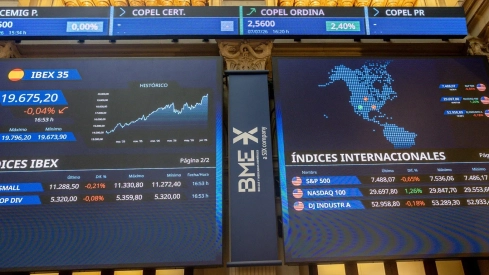
The main index of the Spanish Stock Exchange accumulates two consecutive months of losses and ends October at 18,652.90 points. The fall of banks, doubts about interest rates, and the poor performance of technology companies have marked a complicated month for the markets.
The Ibex 35 ended October with a fall of 3.90%, to 18,652.90 points. This is its worst monthly result since March and represents the second consecutive month in which the main Spanish stock market index closes in negative. The situation has not improved during the last week either. The Spanish selective has lost 1.77% in the last five days and this Friday ended the session with another decline of 1.09%.
Among the reasons for this decline are the losses of banking entities, the negative performance of technology companies, and the increase in public debt interest. The latest decisions and meetings on monetary policy by the European Central Bank (ECB) and the United States Federal Reserve have also influenced.
Why has the Spanish Stock Exchange fallen during October?
One of the sectors that has most influenced the decline of the Ibex 35 has been banking. Investors have sold shares of financial entities, while showing more interest in electricity, gas, and health-related companies. XTB analysts explain that high interest rates do not always benefit banks. Although they can charge more for loans, they also have to face more expensive financing. In addition, customers may request fewer loans and increase difficulties in repaying borrowed money.
The experts from this firm also warn that the end of 2026 may be complicated for the Spanish Stock Exchange. Among the factors that generate uncertainty, they point to the political situation, the increase in bond interest, and the decisions of the European Central Bank. This Friday's session was also marked by the publication of the economic results of several companies. CaixaBank obtained a profit of 4,962 million euros between January and September, 12.9% more than in the same period of the previous year. Unicaja also increased its earnings by 8.1%, to 543 million euros.
For its part, Acerinox has multiplied its net profit by 23, reaching 162 million euros. In contrast, Tubacex has recorded losses of 5.5 million, compared to the profits it had achieved during the first nine months of 2025.
Inflation remains close to 5% and tech companies drag down Wall Street
The Spanish economy also played a leading role during the last day of the month. The National Institute of Statistics (INE) has published that the Gross Domestic Product (GDP) grew by 0.6% during the third quarter of 2026, one tenth less than in the previous three months. In addition, inflation remained at 4.9% year-on-year in October. This means that prices are still 4.9% higher than in the same month last year. The indicator thus chains three consecutive months above 4%.
Losses have also reached the main European markets. The German Dax index fell by 0.85%, the Italian FTSE MIB by 1% and the Euro Stoxx 50 by 1.22%. The French Cac 40 retreated by 0.01%, while the British FTSE 100 managed to close in positive territory with a rise of 0.07%. Across the Atlantic, Wall Street also recorded significant drops, especially in technology companies. The Nasdaq lost 2.66% and the S&P 500 1.61%. One of the most affected companies was Intel, whose shares plummeted 30%.
On the Spanish stock market, Repsol led Friday's gains with an advance of 4.49%, followed by Grifols, with 2.81%, and Puig, with 1.90%. On the other hand, Acerinox led the losses with a decrease of 5.47%, followed by Solaria (-5.10%), Banco Santander (-3.75%) and BBVA (-3.70%). Finally, oil continued to rise. Brent crude, a benchmark in Europe, reached 117.60 dollars, while gold lost 3.10% and bitcoin fell 4.68%, to 77,446 dollars.
