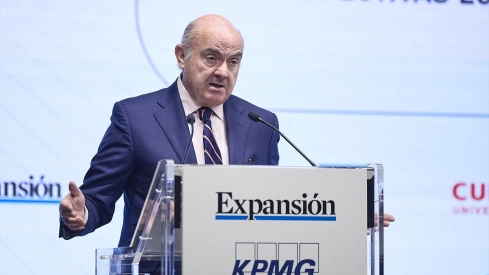
Immigration is "indispensable" for economic growth, according to Luis de Guindos, who has placed its contribution at the center of the advance of activity and employment in Spain and Europe. The former Minister of Economy and former Vice President of the European Central Bank (ECB) has argued that two-thirds of economic growth is due to immigration, which, in his opinion, must be "ordered, legal, and directed".
His statements contrast with the hardening of the migratory discourse of Alberto Núñez Feijóo's PP, which has placed immigration control among its political priorities in a context of competition with Vox. De Guindos' defense of the economic contribution of migrants introduces a nuance in the popular party's debate on this issue, between the need for labor to sustain growth and more restrictive positions on the arrival and regularization of foreigners.
The former minister made these statements in Seville, during the 41st Aecoc Congress of Mass Consumption, where he also addressed other major economic challenges, such as access to housing, taxation on wages, and inflation risks derived from rising energy prices.
De Guindos focused on the real estate market and called for policies that boost the rental supply. In his opinion, the imbalance between demand and available housing is raising prices and generating negative consequences both socially and economically.
The former head of Economy argued that public authorities should respond to the needs of vulnerable groups, although he differentiated this protection from general policies aimed at increasing supply. In this regard, he warned that, according to his analysis, restrictive regulation ultimately harms the most disadvantaged sectors by making access to housing difficult.
Less tax pressure on wages and vigilance over inflation
In labor matters, De Guindos called for moderating and reducing the tax burden on wages to make net salaries more attractive in the short term. "It is necessary to incentivize work," he stated, while pointing to improved productivity as the way to boost long-term growth, although he acknowledged that this process takes time.
The former vice president of the ECB also warned that persistently high energy prices, in a context marked by the Iran war, could cause second-round effects on inflation and force the European body to apply "additional and more intense" interest rate hikes.
For the moment, that scenario has not materialized, he noted, as wage growth remains around 2.5%, practically in line with the central scenario. The evolution will depend, he explained, on whether the conflict prolongs and whether energy continues to be more expensive for longer.