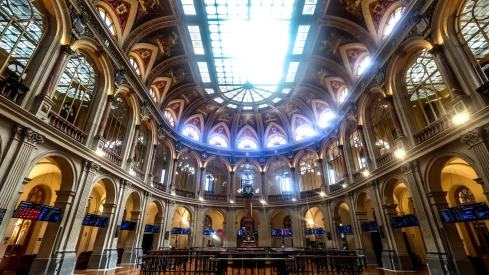
The Ibex 35 closed the week above 20,000 points and it did so with an advance of 3.36%, to 20,020.10 points, in a final session that added 0.27% and left the Spanish selective with an accumulated gain of 15.67% so far this year.
The day was conditioned by the open crisis surrounding Nvidia, by the evolution of the conflict in Iran and by a new round of corporate results, three factors that moved European equities, oil and debt in the same direction of high volatility.
The market follows the pulse of Nvidia and geopolitical tension
XTB analysts maintain that the composition of the Ibex 35 allows participation in businesses with drivers other than the US technology cycle, although the pull has not shielded the index from external shocks.
In the case of Nvidia, the departure of its CEO, Jensen Huang, after 33 years at the helm of the company, opened a new front of uncertainty around the artificial intelligence ecosystem. The until now CFO, Colette Kress, will temporarily occupy the position while the company searches for a replacement.
Renta 4 warns that the market is valuing the implications for the circular financing of the AI ecosystem and also the possible effect on the placement of Anthropic, where Nvidia had committed 10,000 million dollars within a private tranche that is part of a total planned fundraising of 90,400 million.
At the same time, the geopolitical front continued to pressure energy prices. Donald Trump assured that the Iranian regime "is crumbling" and affirmed that Washington exercises total control over the Strait of Hormuz, although these statements do not eliminate uncertainty about supply or sudden movements in the crude market.
The Iranian Revolutionary Guard, for its part, said it had attacked and destroyed an early warning radar of the US Army in Bahrain, in retaliation for a previous bombing against a telecommunications tower in Sirik, in Hormozgan province. That version has not dissipated the tension, but keeps it open while oil continues to react to each new statement.
Brent, a European benchmark, rose to $96.36 per barrel, up 0.56%, while West Texas Intermediate advanced 0.19% to $88.91. Oil relief favors energy-consuming companies, but supply risks continue to set the tone.
Results, inflation, and debt sustain the week's backdrop
On the macroeconomic front, Eurostat raised the eurozone's quarterly GDP expansion to 0.4% in the third quarter of 2026, two tenths less than the 0.6% recorded between April and June. In Spain, the INE confirmed that the CPI maintained its year-on-year rate at 4.9% in October, at levels seen in February 2023, and chained three months above 4%.
The business front also brought movement. Técnicas Reunidas earned 119.6 million euros in the first nine months of 2026, up 12%, and announced that it will resume interim dividends after signing a record portfolio.
Enagás announced, through Enagás Internacional, an agreement with EDF Invest to buy 18% of Teréga for 311 million euros, which will increase its stake in the French firm to 49.5%. Digi Communications, on the other hand, recorded attributed net losses of 54.2 million euros between January and September 2026, compared to a profit of 22.1 million in the same period of the previous year.
On the stock market, the best performers of the day were Repsol (+3.31%), Redeia (+2.90%), Endesa (+1.64%), Iberdrola (+1.54%), and Enagás (+1.27%). On the opposite side, Acciona led the declines with -7.98%, followed by Acciona Energía (-6.89%), Solaria (-3.70%), ArcelorMittal (-3.03%), and Colonial (-2.21%).
Outside Spain, the FTSE 100 advanced 0.36%, the Cac 40 rose 0.09%, and the FTSE MIB gained 0.10%, while the Dax retreated 0.08% and the Euro Stoxx 50 fell 0.19%. In debt, the yield on the Spanish ten-year bond rose to 3.934% and the risk premium stood at 56.90 basis points.
In currencies, the euro fell 0.18% against the dollar, to 1.1035 units, while gold dropped 0.28%, to 3,874 dollars per ounce, and bitcoin fell 4.28%, to 68,666 dollars.
Contact