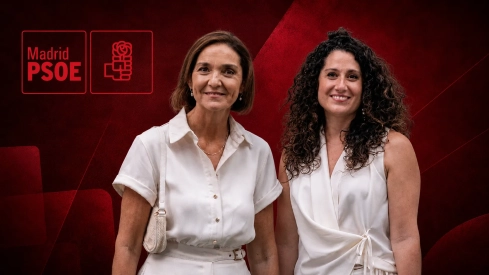
The PSOE primaries to choose its candidate for Mayor of Madrid have ceased to be a mere formality. Enma López secured the endorsements she needed to reach the polls and has turned a race initially favorable to Reyes Maroto into a real dispute, with two projects, two styles, and an internal tension that increases as Sunday's vote approaches.
Maroto starts with an advantage after gathering 1,376 endorsements compared to the 1,028 presented by López, a difference of 348 supports. The data confirms the territorial strength of the current socialist spokesperson and general secretary of the PSOE of Madrid city, but also shows that her rival has a sufficient base to compete.
López has managed to overcome the first major obstacle of a candidacy that was born surrounded by doubts within the socialist leadership. The deputy spokesperson has reached the final campaign despite lacking the organic support that accompanies Maroto and after leaving her position in the Federal Executive to concentrate on Madrid.
The winner will face José Luis Martínez-Almeida in May 2027, who governs the capital with an absolute majority. Before that, she will have to emerge from an increasingly bitter internal campaign, in which both candidates share a municipal group, political office, and a large part of the work carried out in recent years.
Maroto accuses López of disloyalty
Reyes Maroto has raised her tone, in an interview for 'infoLibre', after it was confirmed that there will be a vote. The current spokesperson has accused López of "lack of loyalty" towards her, towards the municipal project, towards the PSOE, and even towards Pedro Sánchez for the way and the moment chosen to announce her candidacy.
Maroto maintains that it was she who personally informed her then number two of her intention to run. López, for her part, communicated her decision when the publication of her candidacy in the media was already prepared. The former minister believes that that move sought individual prominence on the eve of a Federal Committee and the Debate on the State of the City.
"In this party, there is room for everyone and no one is more of a star than another," Maroto affirmed. Her campaign is presented as the candidacy of unity, experience, and fulfilled promises, with the argument that she has remained in the City Council since the 2023 elections and has toured the groups for three and a half years.
The leader has also criticized López for differentiating between endorsements submitted physically at the Casas del Pueblo and those registered confidentially online. Maroto defends that all represent the same commitment and considers it a lack of respect towards the militancy to give greater political value to some than to others.
López had highlighted that her candidacy far surpassed Maroto's in digital support. This result reinforces the interpretation that part of her strength may emerge more clearly when the vote is cast secretly, away from the public exposure of submitting a signature in a party group.
Enma López claims primaries as an act of loyalty
Enma López's response, this morning in an interview for 'El País', avoided reproducing the personal tone used by her rival. "I have never understood democracy and freedom as a form of disloyalty," she replied before defending that competing to lead the PSOE to the Mayor's Office constitutes a show of commitment to the party.
López admits that primaries between colleagues can be tough, although she demands that the campaign look forward and focus on Madrid. She has also confirmed that she will count on Maroto if she wins, just as she intends to integrate other socialist profiles that still lack significant public projection.
Her candidacy defines itself as "pro-Madrid and of the militancy" and seeks to turn the accumulated fatigue during 37 years of right-wing governments into an opportunity to mobilize the progressive electorate. The councilwoman insists that Madrid does not have an unmovable political identity either and recalls the victories of Manuela Carmena and Ángel Gabilondo as proof that the PP can be defeated.
López has accompanied her message of renewal with concrete proposals. In housing, she proposes accelerating construction through industrialized systems, expanding affordable student residences, and offering alternatives within their neighborhoods to seniors living alone in overly large apartments. Her goal is to free up housing, reduce pressure on rent, and deliver new public developments in much shorter timeframes.
In cleaning, she proposes increasing penalties for concessionaires that breach contracts and dividing services into smaller lots, controlled by district boards. She also advocates for greater municipal decentralization to bring management closer to the neighborhoods and correct the differences between some areas and others.
The candidate summarizes her model with the idea of "giving Madrid back to the people of Madrid". Her campaign tries to speak to neighborhoods with higher abstention rates, recover voters who have stayed home, and attract support from other progressive spaces and even former Ciudadanos voters.
Maroto's advantage and the unknown of the secret vote
The endorsements place Maroto ahead, although Sunday's vote operates under different rules. An endorsement publicly identifies the person who submits it, while the vote allows modifying the decision without accountability to the group's structure. This difference fuels the expectations of López's team.
An analysis prepared by political scientist Domènec Ruiz Devesa and published by Agenda Pública calculates several scenarios based on the 5,485 militants called to vote. The simulation starts from a participation similar to that registered in the last competitive primaries in the city and studies how much support Maroto could lose among those who endorsed her.
According to this model, López would have a real chance of winning if Maroto loses around two out of ten endorsers and the alternative candidacy manages to capture a portion of those votes, in addition to mobilizing those who did not sign for any candidate. In one of the analyzed scenarios, López would need to add around 255 additional votes to her endorsements to surpass her rival.
This is a projection and lacks the value of a survey. The exercise serves, even so, to show that the distance is manageable in an election with limited participation and an alternative candidacy that has already exceeded expectations since its launch.
The PSOE's precedents also do not allow the result to be considered final. Josep Borrell, Tomás Gómez, and Pedro Sánchez won primaries at different times against candidacies better connected with the organic structure. The comparison with Sánchez's victory over Susana Díaz in 2017 has begun to circulate among López's supporters, although the two candidates reject equating processes held in very different contexts.
Continuity and renewal to try to recover Cibeles
Maroto presents her permanence in Madrid as her main endorsement. She was a candidate in 2023, increased socialist representation from eight to eleven councilors, and assures that she came to municipal politics to stay. Her project is based on the neighborhood work developed since then, the coordination of the 23 groups, and an agenda focused on housing, cleaning, mobility, and public services.
Among her proposals is to strengthen the Municipal Housing Company, pursue fraud in tourist apartments, and protect public land from investment funds. Maroto also wants to mobilize women and the migrant population against the policies of Ayuso and Almeida.
López represents a change in leadership within the same group that Maroto has led. She was her campaign director in 2023, holds the deputy spokesperson position, and has been a councilor since 2019. This trajectory allows her to claim municipal knowledge while offering a renewal of profiles, language, and electoral strategy.
The dispute thus pits the continuity of a project that improved socialist results against a candidacy that considers it insufficient to settle for advancing from the opposition. López argues that the PSOE must once again have a direct vocation for government in the capital and has made that ambition the core of her campaign.
Both have shown themselves willing to hold a face-to-face debate before the polls. Maroto wants to confront the two ways of presenting the PSOE to the people of Madrid, and López argues that the militancy should directly know the proposals of each candidacy.
Madrid will be, along with Oviedo, Ferrol, and Torrelavega, one of only four city councils where the PSOE will hold contested primaries during this first phase. In the rest of the territories included in the call, only one candidacy managed to gather the required endorsements.
The 5,485 socialist militants in the capital will be able to vote this Sunday, July 19. Until then, Maroto and López will tour the groups and neighborhoods to decide who will lead the PSOE's attempt to return to the Palacio de Cibeles 38 years after its last municipal victory.
