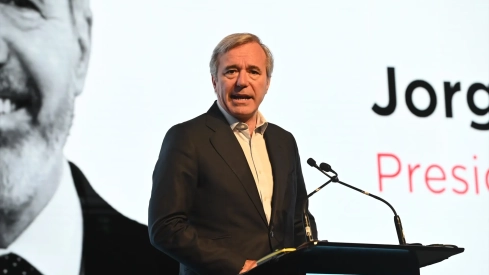
The president of the Government of Aragon, Jorge Azcón (PP), raised the political tone this Friday in the plenary session of the Cortes de Aragón, where he accused the head of the central Executive, Pedro Sánchez, of having turned Spain "into the laughingstock of the world" due to his management of the migratory invasion of Ceuta.
In response to a question from the socialist group's spokesperson, Pilar Alegría, the regional leader defended that his Executive works "to serve the Aragonese people", while reproaching the minister that, in his opinion, she acts to "serve Sánchez", in an exchange marked by references to national politics, the crisis in the autonomous city and the internal situation of the PSOE.
Clash with Pilar Alegría in the plenary session of the Cortes
He insisted that what is happening is that, when a government "wages a hybrid war against our country", the president of the central government "all he does is kneel before Morocco", and added that "who knows what they know in Morocco for the Government of Spain to be doing what it is doing with the Ceutians". The Aragonese president also stated that what he does is "serve the Aragonese people" and what Pilar Alegría does is "serve Sánchez", in allusion to the position of the socialist spokesperson in the autonomous Chamber. Furthermore, he recalled, according to his intervention, the "face she made when she ran for elections and obtained the worst result in the History" of Aragon, a reference he extended to "the left-wing deputies", and predicted that the same would happen to them in the general elections on November 29.
"Yesterday Pedro Sánchez went on television to laugh, but the Ceutians don't laugh much," Azcón continued, for whom the central Executive "serves the Government of Morocco, the independentists and pro-ETA groups, even the worst sewers of the State or drug trafficking clans," but "who it certainly does not serve is the Central Operative Unit (UCO), the Civil Guard and the judges."
In the same debate, the president of Aragon asked "where are the PSOE's invoices?" and questioned how it could be that the Civil Guard is demanding that documentation and the party "has the nerve to tell a judge that they can't find them", a situation that, he said, would not happen with a citizen.
Azcón defends the regional budget and talks about health, education and housing
Beyond the political clash with the socialist group, Jorge Azcón defended his government's management and put figures to some of the items planned for next year. Thus, he pointed out that the Health budget will rise to 3.1 billion euros, with an increase of 350 million euros, while teachers will see their salaries increased by 7.75% and the Housing item will reach 52 million euros.
In that context, the regional president maintained that love does not solve the problems of the shopping basket or the rise in gasoline prices, and criticized the PSOE's campaign strategy. "You start making a declaration of love and dancing at rallies; I am certain that your face will be a poem the day after the general elections," he stated.
Pilar Alegría's criticism and the debate on housing aid
For her part, Pilar Alegría asked Azcón "who, really, does his Government serve?" and considered that "his interest is not in solving the problems of ordinary Aragonese people," while emphasizing his "sectarianism and political incompetence."
The socialist leader maintained that this "sectarianism" is preventing Aragonese people from receiving aid from the Government of Spain for communities with strained areas, despite the fact that, she said, they meet the requirements by allocating more than 30% of their income to paying their mortgage or housing rent.
"What would become of you without Sánchez?" Alegría asked him, considering that the Aragonese president wants Sánchez to win the elections on November 29 because, without him, he would be "a lame politician." According to her intervention, in these three years Azcón has dedicated more energy to despising and criticizing the Government of Spain than to solving the problems of the Aragonese people.
The socialist spokesperson also reproached the PP for "calling into question" the validity of the electoral system, in reference to postal voting, and warned that, if the popular party governed Spain, they would "privatize and cut pensions, sick leave, the minimum interprofessional wage, and women's rights."
Postal voting, at the center of the clash with Jorge Pueyo
In another of the day's interventions, the president of the Government of Aragon reiterated that he does not trust postal voting in the general elections on November 29 and assured that "if the PSOE doesn't cheat more, it's because it can't".
Azcón thus responded to a question from the spokesperson for CHA, Jorge Pueyo, in the plenary session of the Cortes de Aragón, where he reproached the Chunta leader for being the only one in all of Spain who has brought to the Electoral Board the doubts —in this case Azcón's— about postal voting. The Aragonese president promised that, if that body determines that his statements constitute a breach of regulations, he will apologize, and challenged Pueyo to do the same if the resolution is favorable to him.
The regional president criticized the Chunta spokesperson for "not running" and for having made it clear that "he is concerned about votes from Teruel, not the people of Teruel", in addition to maintaining that the "chuntipsoe is not running and accepts what the PSOE has done for the province of Teruel", a scenario before which, he said, the people of Teruel from CHA "will take good note".
Pueyo accuses the PP of going hand in hand with Vox
In his reply, Jorge Pueyo stated that PP and Vox "now go hand in hand" and that Azcón "has adopted Vox's most extreme positions", while downplaying the criticisms of popular leaders regarding postal voting, understanding that "they have been benefiting from the electoral system for enough years to question it".
Pueyo also recalled that Azcón "received his first salary at the Zaragoza City Council in pesetas" and, in relation to the doubts raised by the Aragonese president, stressed that "what is legal and what is moral often do not go hand in hand", before asking him if he retracts his words about the alleged fraud and if he will apologize to Correos employees.
The exchange showed a new example of the political confrontation between the Government of Aragon, the PSOE and the opposition groups, with migration, the management of the central Executive and postal voting at the center of the parliamentary debate.