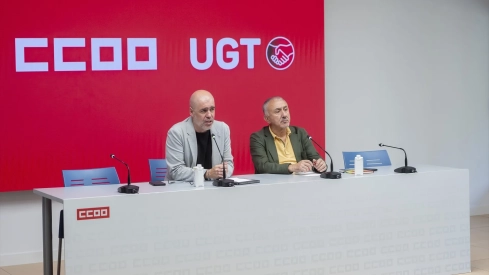
CCOO and UGT agree on a 24-hour general strike this autumn to demand access to decent housing and sufficient wages to pay for it. The two main unions take up the demand that has been present in the weekend's demonstrations and take a decisive step to bring the protest to workplaces. The agreement must be ratified by their highest governing bodies and there is still no fixed date.
The organizations led by Unai Sordo and Pepe Álvarez will decide the day of the strike with the Tenants' Union and other social platforms. In their joint statement, they expressly link the housing crisis with the purchasing power of workers. "Wages are not enough to pay for housing and face inflation," they warn.
The decision comes on the same day that Pedro Sánchez announces general elections for November 29, after the parliamentary rejection of the two housing decrees last Friday. According to 'El País', the unions foresee that the strike will take place before the elections, although their statement only sets autumn as the horizon and leaves the date to coordination with social organizations.
The early election thus finds a mobilization that continues to grow. The union protest is directed at all administrations with housing competencies and business organizations, to which it demands wages capable of covering basic needs. The central government, autonomous communities, and city councils are challenged by a demand that the organizers also want to sustain during the campaign.
🔴UGT y CCOO acuerdan la convocatoria de una huelga general este otoño
— UGT (@UGT_Comunica) October 5, 2026
📢Los sindicatos incorporan el conflicto de rentas en el marco de las grandes movilizaciones por la vivienda. Los salarios no alcanzan a pagar la vivienda y hacer frente a la inflación.
👊Llamamos a las… pic.twitter.com/eULUQKCPwe
From the streets to the workplaces
The call has behind it a succession of protests that intensified after the eviction of Maricarmen, the octogenarian evicted from her home in Madrid. On Friday, PP, Vox, Junts and UPN voted against both housing decrees; PNV and Coalición Canaria also joined in the rejection of the second. The fall of the measures provoked new calls and reinforced the demand for a general strike.
On Saturday, some 70,000 people, according to the Government Delegation, demonstrated in Madrid in four columns that converged in Cibeles. "Towards the general strike" was the slogan of the main banner. The march was part of the mobilizations called in more than 50 cities, with the right to housing and the rejection of speculation as central demands.
CCOO and UGT had already called to fill the streets after meeting on Friday with the Tenants' Union. Now they agree on a full-day strike and recognize the impulse of these protests. "Last weekend's demonstrations have shown the strength of that demand," they point out, before arguing that the response must be built among all the organizations involved.
The support of the majority unions is added to that of CGT, which this Sunday placed the housing strike among its priorities when closing its confederal congress. Its general secretary, Miguel Fadrique, defended coordination with tenant unions and social movements to set a date. The incorporation of CCOO and UGT expands the capacity to take that call to companies and sectors throughout the country.
Meanwhile, the Puerta del Sol encampment continues. This Monday, before the union announcement, the spokesperson for the Tenants' Union, Alicia del Río, insisted on maintaining pressure despite the early elections and called for convergence with the struggles for healthcare, education, pensions and wages. The movement argues that its demands must remain present regardless of who wins the elections.
Wages to be able to pay for a home
The agreement revives a tool that the main unions had not used jointly throughout the country for a full day for almost fourteen years. The last precedent is November 14, 2012, when CCOO and UGT called a general strike against the cuts and austerity policies of the Government of Mariano Rajoy. If ratified, this would be the first joint 24-hour national call under the presidency of Sánchez.
Since then there have been other calls with different scope and union support. On October 15, 2025, for example, CGT and other organizations promoted a 24-hour strike in solidarity with Palestine, while CCOO and UGT called partial two-hour strikes. This precedent makes it necessary to specify the scope of the decision announced today, which commits both unions to a full-day general strike.
Wage demands are based on the unions' proposal for the VI Agreement for Employment and Collective Bargaining, the framework with which they seek to guide the negotiation of agreements. They demand increases of between 4% and 7%, wage review clauses, and measures that facilitate access to housing. With this, they intend that the cost of having a home be part of the discussion about how much wages should rise.
Regarding housing, the unions demand to limit rental prices, expand a public park of protected housing that permanently retains that condition, and effectively apply the Law for the Right to Housing in all territories. Their decalogue also calls for a social and political pact. The pressure extends to employers to renew the wage agreement and unblock collective agreements.
The call already finds the opposition of the president of the CEOE, Antonio Garamendi, who this Saturday questioned in O Grove a general strike for housing, considering that this reason "is not within a labor conflict". The unions reject this interpretation and highlight the relationship between housing prices and workers' living conditions. The agreement expressly incorporates wages and collective bargaining into the reasons for the strike.
CCOO and UGT call to extend the campaign in workplaces and on the streets, while preparing the ratification and the definitive date with the housing movement. "We will continue in mobilization and collective bargaining until housing ceases to be a privilege, and wages allow for living with dignity," they state.
