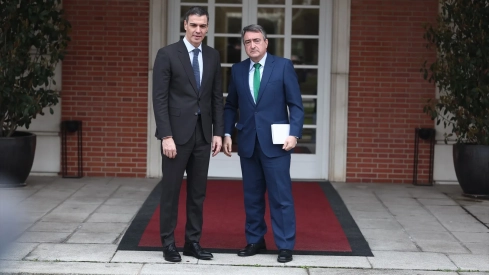
The Government of Pedro Sánchez cools down the new controversy opened with the PNV and lowers any reading of political crisis after the information pointing to the discomfort of the Basque nationalists with the direction of the legislature. From Moncloa, the matter is circumscribed “to the sphere of the parties” and, specifically, to the relationship between PNV and PSE, avoiding raising the tone or presenting the episode as a clash with the central Executive.
Government sources maintain that it is both formations in Euskadi that must redirect their possible disagreements and underline that the Executive knew about the planned meeting between both parties, thus reducing dramatism to the appointment. In the Government's engine room, a message of institutional normality is transmitted: there is no alarm, nor rupture, nor change of scenario.
La Moncloa also places the focus on the direct relationship with the Gobierno Vasco, which it defines as fluid and constant. According to these sources, the contacts are frequent and are yielding results, an expression with which the Executive wants to convey an image of stability and joint work despite the political noise.
In parallel, Sánchez's inner circle claims the "loyalty" historically maintained with the PNV and emphasizes that the dialogue between both parties has always been sincere and positive. A message with clear political intentionality: against those who speak of parliamentary exhaustion or tired partners, the Government responds with continuity, pragmatism, and open bridges.
Thus, while some voices interpret the PNV's move as a wake-up call in the face of a worn-out legislature, in Moncloa another narrative prevails: that of a specific, manageable discrepancy with no real impact on the stability of the Executive.