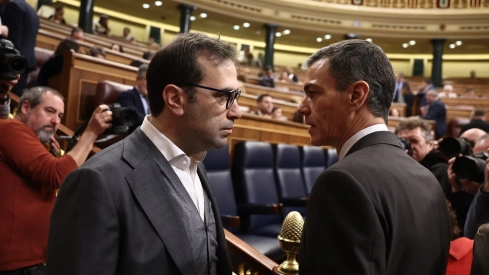
There will be a double trip and, therefore, a double objective. Next week, the President of the Government, Pedro Sánchez, will travel to China, while the Vice President and Minister of Economy, Carlos Cuerpo, will travel to the United States in what will be his first official trip after taking office. Each with their own agenda, but with the same direction: to strengthen commercial relations and open new business avenues for Spain in an increasingly competitive international context.
First it will be Sánchez, with his fourth trip to China in little more than three years. Between April 13, 14 and 15 he will have the opportunity to strengthen dialogue with “a friendly country,” according to explanations in Moncloa, in a clear gesture of proximity with Beijing and with its leader, Xi Jinping. All this, furthermore, at a time when the political distance with the Administration of Donald Trump is becoming increasingly evident.
The international situation always weighs, but on this occasion the backdrop is marked by the crisis in the Middle East. A ceasefire announced for the coming weeks —pending consolidation— hovers over a meeting to which both leaders arrive with good diplomatic rapport.
You to China and I to Boston
In Moncloa, they make Sánchez's trip to the Asian giant coincide with another move that seeks to send "a clear signal" to the markets: Carlos Cuerpo will debut in Boston. A debut with a practical vocation.
Already in March he announced the opening of new commercial offices —also in Houston— to reinforce the support for Spanish companies in the United States. That will be the central axis of his agenda: to consolidate the Spanish business presence in one of the most competitive markets in the world.
Additionally, Cuerpo will participate in the spring meetings of the International Monetary Fund and the World Bank, which are held in Washington between April 13 and 18. A key forum where the main economies will analyze how they are managing the impact of the war on markets and supply chains.
The ceasefire does not pay bills
From the Body team they insist that they continue evaluating the impact of the package of measures approved two weeks ago. The priority, they underline, is “maintain prudence” before adopting new decisions that, for now, are not in the short term.
They recall that the current measures are designed for a three-month horizon and, although they trust in a progressive de-escalation, they warn that “the necessary decisions will be taken” to protect families and businesses if the context demands it.
Because, although the ceasefire would be the desirable scenario, in the Government they assume that the economic earthquake can last for months. The end of the war does not imply, by any means, the immediate disappearance of its effects.
Amidst full geopolitical fragmentation and with supply chains under pressure, Moncloa makes a move: diversify alliances, gain strategic autonomy, and position Spain as a reliable —and competitive— actor in the new global economic order.