“Don't risk it this time.” The phrase is signed by the spokesperson for the PNV, Maribel Vaquero, and it is a direct warning to Pedro Sánchez on account of the royal decree that he will approve this Friday with the first economic measures to face the effects of the war in Iran.
What does it warn him about? That time is running. And not precisely in favor of the Government.
Less than 48 hours remain for that extraordinary Council of Ministers —the legal instrument to approve the package— which, however, still does not have the support of the parliamentary groups. It is they who will have to validate it next week in Congress. And there is no support, among other things, because no one knows for sure what measures will be included.
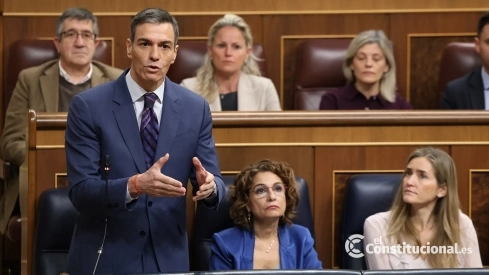
“I warn you, Mr. Sánchez: don't you dare bring the measures in an omnibus decree, as he did with pensions.” This second warning —which in reality has been the first of the morning— has been launched by the leader of the opposition, Alberto Núñez Feijóo, after accusing the president of “taking advantage of the war.”
The president has responded in substance and form. He has reproached the PP that “if the PP and Vox governed, we would be in another photo of the Azores”. And he has conveyed to the PNV that he hopes to find consensuses “for the good of the country” and for the “responsibilities” that all parties have.
Game of balance
Government sources insist that “they are still negotiating” because “the will is for the measures to gather the largest number of votes” in Congress. They recognize the difficulty and describe it as “a game of equilibrium”: finding a formula that allows integrating proposals from different groups without breaking the majority.
But that narrative collides with the one that the parliamentary partners themselves convey.
In Podemos they doubt the “no to war” of the Executive. This is how the leader of the purples, Ione Belarra, has reproached him, and in the group they recognize that the interlocution is “rather little”. In the PNV they admit that they expected to hear the president today in a control session “to see what he said” in public, because in private there is no concreteness. EH Bildu, like the rest of the groups that have already submitted proposals, remains waiting to know the real content of the measures.
With Junts, the bridges remain broken. And with the PP there has been no more contact than the call that the Minister of the Presidency, Félix Bolaños, made last week to the popular spokesperson, Ester Muñoz.
Agreement yes, but not at any price
Sumar and other partners like ERC or EH Bildu demand that the decree include measures regarding housing and tenant protection. On this point, journalists asked the Minister of the Presidency, Justice and Relations with the Cortes, Félix Bolaños, upon leaving Congress. Before he could respond, the Minister of Health, Mónica García, intervened with a "sure".
Bolaños, laughing, corrected him: “It's not so sure”, although he added that “they are going to work on it”.
It is, in fact, one of the main stumbling blocks within the investiture bloc itself.
For his part, Sánchez has advanced that the package will be structured around two pillars: one, of immediate response to the conjuncture, with specific aid to the most affected sectors; and another, focused on accelerating the ecological transition to reinforce Spain's energy autonomy. A scheme that, in reality, had already been anticipated.
The precision, today, has been set by the PNV: “We are willing to work together and improve the measures, but do not forget that everything that the Council of Ministers approves is not definitive: it will have to be approved here”.
And so it will be. With the recent precedent still very present: the parliamentary defeats of late February, when the Plenary of Congress struck down two key decrees for the Executive.