“Another historic day”. The phrase is repeated among journalists in the press area of the Congress of Deputies. However, the reference this time does not point to the plenary hall, but to what is happening barely a kilometer away, within the walls of the Audiencia Nacional, where for the first time a former President of the Government declares as investigated.
Spanish politics has become accustomed to turning into reality scenarios that until recently seemed unthinkable. And, at the same time, there are scripts that end up unfolding exactly as predicted. This happened again this Wednesday in Congress. Although no one explicitly verbalized it, the issue hovered over all interventions: corruption. And, in the background, the declaration of José Luis Rodríguez Zapatero before judge José Luis Calama.
The leader of the Popular Party, Alberto Núñez Feijóo, arrived at the session with two messages addressed to the President of the Government.
The first had to do with the decision adopted this Tuesday by the Bureau of Congress to vet the amendments registered by the PP and Junts to urge Pedro Sánchez, through a non-binding initiative that was to be voted on this Thursday, to call elections. Feijóo accused the president of acting like a “coward” and of “gagging” Parliament. Faced with these criticisms, Sánchez defended the action of his Executive and maintained that Spain is today a “better country” after his two legislatures at the head of the Government.
The second message came in the form of a question. “Does Mr. Zapatero still have your support or from now on was he acting on his own?”, Feijóo launched from the tribune, trying to link the president with the judicial situation of his predecessor. Sánchez avoided getting fully into the matter and responded by attacking the opposition's strategy. “It never ceases to surprise the moral watchtower from which you become a Torquemada of life”, he replied.
But the Government's problems do not only come from the popular bench. The parliamentary partners insist again that the legislature is going through a critical phase. Although Congress will not be able to rule on what the opposition considers a priority, the dissolution of the Cortes, the message resonated strongly again in the plenary hall.
The PNV spokesperson, Maribel Vaquero, wanted to focus her intervention on the General State Budgets despite “the judicial agenda of her environment and that not even the World Cup will be able to eclipse.” During her speech, she reminded Sánchez that “he has lost the investiture majority” and warned him that the current situation “is ending the PNV's faith.”
A scenario that reflects the growing parliamentary fragility of the Executive. Because while Sánchez insists on exhausting the legislature and vindicating his Government's management, some of his partners are beginning to openly question the viability of the majority that led him to La Moncloa. The blue bench appears increasingly diminished and with greater difficulties in sustaining the political initiative. In a fragmented Congress, majorities are not maintained by inertia.
The President of the Government also left Congress the same way he arrived: without making statements to the media and avoiding any public reference to José Luis Rodríguez Zapatero's statement before the Audiencia Nacional.
Diana Morant comes to Zapatero's defense
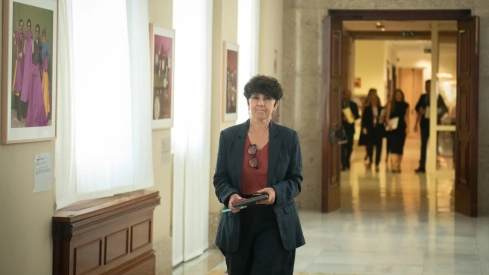
The Minister of Science, Innovation and Universities, Diana Morant, was one of the few members of the Executive who spoke to the media in the corridors of Congress this Wednesday. Many of the questions revolved around José Luis Rodríguez Zapatero's statement and the information affecting him.
Morant avoided distancing herself from the former president and defended the need to address more broadly the debate on the role and obligations of those who have held the Presidency of the Government. In that context, she wondered if Zapatero is “the only former president” who has received gifts during his institutional period, in reference to the jewels seized by the UCO in a safe located at the socialist headquarters on Ferraz street.
The minister also assured that there is a consensus within the PSOE to regulate the figure of former presidents more clearly. And, when asked about the ethical limits of certain actions once out of office, she directed her criticism towards José María Aznar, whom she reproached for maintaining a permanent strategy of confrontation against Pedro Sánchez's Executive.
Ferraz and La Moncloa, awaiting every word from Zapatero
The political attention of the day was not only in Congress. In Ferraz and La Moncloa, every word uttered by José Luis Rodríguez Zapatero before Judge José Luis Calama was followed with special attention.
The political scope of his statement could be decisive for the coming weeks. If the former president's explanations convince the magistrate and reduce the pressure accumulated over the last few days—with a growing sense of crisis about to overflow—the Government will gain some oxygen in one of the most delicate moments of the legislature.
On the contrary, if new questions arise from the appearance or any judicial decision that further tightens the political siege on the Executive, La Moncloa will have increasing difficulty in building an effective firewall. And, above all, in achieving the objective that today appears as a priority: to reassure increasingly uncomfortable partners and deactivate an opposition that has found a new front of attrition in this matter.
Add ElConstitucional.es as a preferred Google source for free.
Stay informed about all the latest breaking news with the best information. Against disinformation, for democracy and social rights.