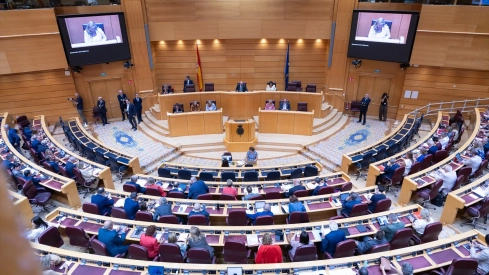
The Popular Party has used its absolute majority in the Senate this Tuesday to approve a broad battery of measures on the Ceuta crisis. The motion demands the Government to activate the National Security Law, accelerate returns, reinforce the border, and temporarily grant the status of agents of authority to the military deployed in the autonomous city.
The initiative has gone ahead with the votes of the PP, the far-right Vox, and UPN. PSOE, PNV, ERC, BNG, and EH Bildu have voted against, while Junts did not participate in the vote. The motion is political in nature and does not oblige the Executive to apply its measures.
The morning ended up becoming a monographic session on Ceuta. The PP has recovered the proposal rejected last week by Congress and has added two requests. The first demands that members of the Armed Forces displaced to the city can act as agents of authority. The second demands that the Cortes receive "sufficient and permanent" information when a similar crisis occurs.
"It has been 47 days since Ceuta was invaded and the assault on the border by Morocco took place," opened popular senator María Carmen Cobo. Since then, the PP's interventions have combined criticism of the Government's management with direct accusations against Pedro Sánchez for his relationship with Rabat.
Cobo has reproached the president for going on vacation and now trying to justify his actions "from set to set". She has also demanded explanations about previous warnings from the National Intelligence Center and has called for the immediate return of those who entered irregularly and have no right to remain in Spain.
National Security, returns, and 650 million
The approved plan is structured in nine blocks. The PP demands to declare in Ceuta a situation of interest for National Security, convene the National Security Council, and designate the functional authority provided in the law to coordinate the response of all administrations.
The motion also requests a calendar to resolve the files of those who entered on July 30 and 31 and activate, with the corresponding legal guarantees, voluntary return or expulsion procedures. The popular party also advocates resorting to European mechanisms for crisis situations and migratory instrumentalization and requesting an immediate deployment of Frontex.
On the border, the text proposes to increase human and technological resources and extend the surveillance perimeter offshore. It also demands a permanent institutional presence of the State in Ceuta and that any future crisis in the city be treated as a national issue.
The economic section includes a reactivation plan for Ceuta and Melilla endowed with at least 650 million euros between 2027 and 2032. The proposal contemplates a special regime law, improvements in connectivity, incentives for trade and hospitality, actions against youth unemployment, and a reinforcement of public services.
The senator from Melilla, Isabel María Moreno Mohamed, has argued that Spain must maintain good relations with Morocco based on "equality" and "reciprocity." "What does Sánchez owe Morocco for his position to be one of capitulation and permanent humiliation?" she asked.
The intervention again hinted at the PP's suspicions about a possible blackmail related to information extracted from Sánchez's phone using the 'Pegasus' spy program. So far, it has not been accredited that Morocco is using this data to condition the Spanish Government.
The PP has also brought to the plenary a motion focused on the safety of women and minors. Carmen Pobo cited 23 sexual assaults since the beginning of the crisis, five of them with penetration and nine with underage victims. "Ceuta does not ask for privileges. Ceuta asks Spain to fulfill its obligation," she stated.
The PSOE accuses the PP of fueling the crisis
The socialist senator María Jesús Álvarez has accused the PP of using Ceuta to wear down the Government and compromise Spanish foreign policy. She has also reproached the popular party for spreading unproven suspicions about Morocco and fueling disinformation in the midst of the crisis.
Álvarez has described the PP's strategy as "tin patriotism" and has warned that some speeches are contributing to "incubate the serpent's egg of hatred and xenophobia." The socialist has recalled the words of Vox leader José María Figaredo, who even demanded that migrants remaining in Ceuta be "hunted one by one".
Carmela Silva has accused the popular party of politically prolonging the crisis to gain electoral advantage. "Are girls, women, children, and vulnerable people invaders?" she asked after the PP again used the term "invasion" to describe the massive entry.
The PNV rejected the motion, but also directed part of its criticism at the Executive. Nerea Ahedo ironized that the PP repeated in the Senate an initiative almost identical to the one debated in Congress and, at the same time, questioned Sánchez's delay in taking charge of the crisis and his lack of response to Morocco.
ERC has accused the PP of acting with "hypocrisy and demagoguery" in the face of an emergency that also has social and humanitarian dimensions. The far-right Vox, for its part, has supported the text, although it has asked the popular party to go further and study mechanisms to demand accountability from Sánchez. "Our Constitution has sufficient mechanisms to be able to prosecute Sánchez and from Vox we offer them our support," launched Santiago Abascal's party.
Ceuta also burst into a motion on the health situation. The former Madrid councilor Enrique Ruiz Escudero spoke of "absolute collapse" and compared the pressure on emergencies to a war situation. Carla Antonelli responded by recalling the 7,291 deaths in Madrid residences during the pandemic, while the PSOE brought to the plenary session information about the alleged manipulation of waiting lists at the Ramón y Cajal Hospital.
The main motion on Ceuta has been approved as a political position of the Senate. Its application will now depend on the Government, which is not obliged to execute the measures agreed upon by the popular majority.
Add ElConstitucional.es as a preferred Google source for free.
Stay informed about all the latest breaking news with the best information. Against disinformation, for democracy and social rights.
