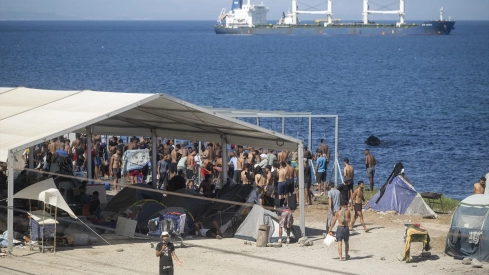
The judge of the National Court María Tardón continues to investigate the massive entry of migrants into Ceuta on July 30. This Monday, October 26, two commanders who were present during the events have testified: Lieutenant Colonel of the Civil Guard Miguel Lobo and Chief Inspector of the National Police Lorenzo Juan Fages.
Both have explained to the magistrate how the arrival of thousands of people from Morocco unfolded and what decisions the Spanish agents made to respond to the situation. Their testimonies also point to the actions of the Moroccan authorities, although their statements will have to be contrasted with the rest of the evidence from the investigation.
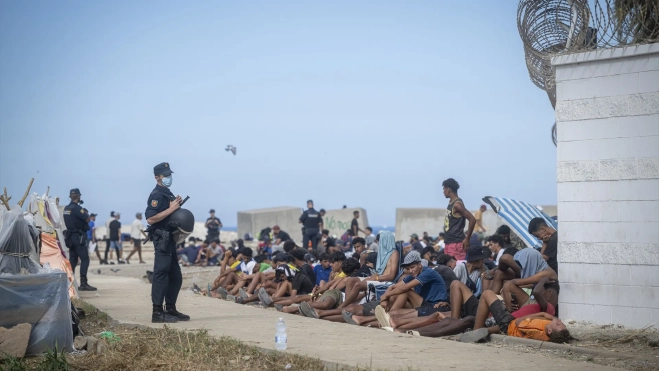
One of the most notable facts is that the head of Civil Guard Operations has assured that he saw six Moroccan boats the night before the massive entry. In addition, the two commanders have offered different versions about the decision to keep a border gate open to prevent people from accumulating in a confined space.
What did the Spanish commanders see before entering Ceuta?
Lieutenant Colonel Miguel Lobo has declared that the Civil Guard informed the Government delegate of the presence of six Moroccan boats the night before the massive entry. According to his testimony, there were two patrol boats, two interceptor boats, and two smaller ones.
The commander explained that he was struck by the fact that there were so many boats on a foggy night. However, he could not confirm if the boats were within Spanish waters, as it was difficult to determine their exact position from the coast. Lobo also pointed out that the Moroccan military remained without intervening while the migrants advanced. According to his version, some Moroccan agents directed people towards the breakwater and small boats transported them to the beach. The commander assured that Spanish civil guards had to rescue people from the water to prevent them from drowning.
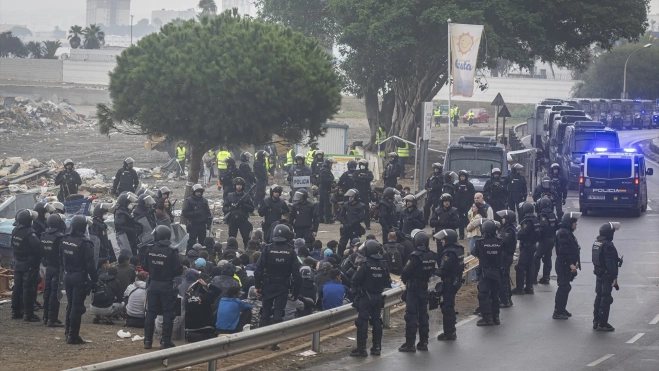
For his part, the chief inspector of the National Police, Lorenzo Juan Fages, stated before the judge that there were Moroccan agents who facilitated the passage to Ceuta. According to his statement, he saw uniformed and plainclothes people making gestures for migrants to advance. The police commander described a long line of people on the other side of the border and assured that the entry occurred "without prior alert or an extraordinary deployment". He also stated that more resources had been requested and that the National Police protocol was not activated.
Why did the National Police and the Civil Guard clash?
Another central point of the investigation is the disagreement between the two Spanish forces on how to control the entry. While the National Police advocated closing the gate to stop the passage of people, the Civil Guard opted to keep it open to avoid a dangerous accumulation.
Miguel Lobo assumed responsibility for that decision before the judge. According to legal sources cited by EFE and RTVE, the commander assured that he made the "operational decisions" and that he did not receive instructions from the Government delegate or other superiors. The lieutenant colonel argued that closing the gate could cause a human "bottleneck" and lead to stampedes. He also explained that, given the arrival of thousands of people, it was impossible to detain all migrants with the available agents.
The version of the chief inspector of the National Police was different. The commander considered it necessary to close the gate to stop the entry and pointed out that there was a lack of instructions and resources to deal with the situation. According to his testimony, the Civil Guard ordered the reopening of the access after it had remained closed for a few minutes. Judge María Tardón seeks to clarify what information the authorities had before the events, how the actions of the police forces were coordinated, and what decisions were made during the massive entry.
The investigation will continue in the coming days with the statements of three counselors of the Government of Ceuta: Alberto Ramón Gaitán, Nabila Benzina, and Alejandro Ramírez. On Wednesday, three other agents who were on duty during the events are scheduled to appear. The magistrate intends to reconstruct what happened at the border and determine what information was available at each level of institutional responsibility before and during the crisis.
