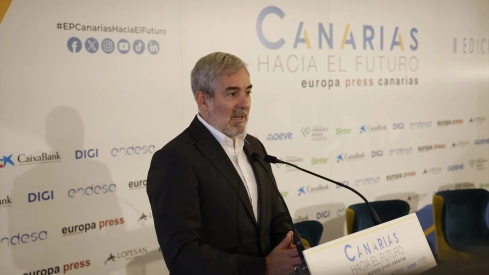
The president of the Government of the Canary Islands, Fernando Clavijo, on Tuesday criticized the central Government for its "lack of foresight" in addressing the resurgence of the migratory crisis in the islands, especially in El Hierro, where, as he denounced, "no progress has been made".
In a press conference after the conclusion of the second interministerial commission, Clavijo did acknowledge "progress" in the transfer of migrants to other islands and to the Peninsula, a measure that, in his opinion, "alleviates" the pressure in El Hierro, although he insisted that these movements are still "insufficient".
The Canarian president pointed out that, currently, what he considers "the most distressing" is healthcare, because no additional reinforcements have been incorporated nor has a field hospital been installed in the Temporary Foreigner Care Center (CATE) of San Andrés, as his Government has requested.
"What they have told me is if we can continue to make a greater effort and transfer people from other islands", explained Clavijo, while reproaching the central Executive for not having received "not a single euro" of the 15.3 million euros foreseen in the contingency plan for El Hierro, although the Government has announced that it will approve an urgent royal decree with five million euros.
Las respuestas a la situación crítica de El Hierro no pueden seguir demorándose. El Gobierno del Estado no solo tiene que desplegar las medidas acordadas la pasada semana sino, tal y como he pedido al presidente Pedro Sánchez, activar de forma inmediata los recursos europeos. Es justo para los herreños, para los canarios y para quienes llegan a las islas.
— Fernando Clavijo (@FClavijoBatlle) November 16, 2026
El Hierro, healthcare and pending resources
Clavijo has focused on the situation in El Hierro, where the pressure derived from the arrival of migrants continues to condition the response capacity of the administrations, both in terms of assistance and organization. The regional president has argued that the care of these people requires more resources, more coordination and agile referral to other territories to avoid the collapse of available resources on the island.
As he has reported, the lack of health reinforcements and the absence of the field hospital in the CATE of San Andrés continue to be two of the main pending problems, in a context in which the Canary Islands insists that the State's response has not materialized at the necessary pace.
He recibido la llamada del Lehendakari @Imanol_Pradales que una vez más se ha interesado personalmente por la emergencia migratoria que estamos viviendo en El Hierro y ha puesto a disposición de Canarias los recursos de #Euskadi que puedan ser necesarios. Le agradezco sinceramente su preocupación, su disposición y la solidaridad del pueblo vasco. En momentos como este, la colaboración entre territorios es fundamental y debe traducirse en hechos. #emergenciamigratoria #rutacanaria
— Fernando Clavijo (@FClavijoBatlle) November 15, 2026
"Absolute nonsense" about deportation centers in Rwanda
Furthermore, the president of the Canary Islands has called the creation of immigrant deportation centers in Rwanda an "absolute nonsense", a formula agreed upon by Germany, Denmark, Greece, the Netherlands, and Austria, considering that it does not guarantee the fulfillment of human rights nor will it stop migratory flows.
"It seems like absolute nonsense to us. They are people, and when you have been at the dockside, you see them disembark and they are children, you understand that in the last century more than half a million Canarians had to emigrate and that opening this type of centers where there is not the slightest guarantee of the fulfillment of human rights does not seem the most suitable", he stated.
After attending the extraordinary meeting of the Interministerial Immigration Commission in Moncloa, Clavijo maintained that these facilities, contemplated in the new European Pact on Migration and Asylum, are not the solution to the migratory phenomenon.
The Canarian president also warned that this measure will not stop arrivals in Europe, but rather may push migrants to routes "of greater danger and with more deaths, undeclared economy, and human trafficking".
Criticism of the capacity of these centers and the political debate
Clavijo also questioned the capacity of these centers by comparing the 100 places of the planned device with the 1,350 people who arrived in a single day in the Canary Islands. "It is making cheap politics and populism, if you allow me, with the suffering of people", he criticized.
The president of the Canary Islands has acknowledged that migratory pressure worries the Archipelago, both due to the overload its population bears and the need to guarantee safe care for those who arrive and then articulate their transfer to other territories.
For this reason, he insisted that the creation of deportation centers "is not the way" and recalled that his Government had already warned of the consequences of this type of approach.
Finally, Clavijo alluded to the words of the Pope during his visit to the Canary Islands and maintained that the path he proposed then does not coincide with the measures being adopted now. "Everyone applauded, everyone shared, everyone beat their chests, but look what is happening to us", he concluded.
Contact