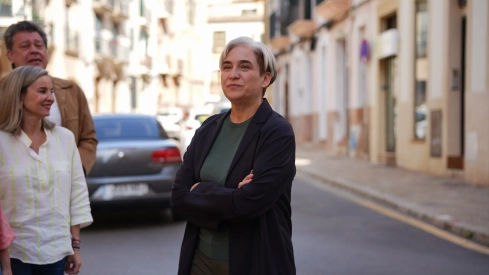
The candidate for Frente Amplio, Ada Colau, has acknowledged that the division of the alternative left has been the main problem that has plagued her political space, generating, as she said, weariness among citizens, and at the same time has championed one of her most striking programmatic banners: that taxes “are sexy” when they affect the “mega-rich”.
During her interview on La Revuelta, the former mayor of Barcelona also defended that the treatment of the monarchy should be limited to “minimal cordiality”, assured that she has not been “PSOEized” by the President of the Government, Pedro Sánchez, and reproached the socialists that the housing problem “costs them a lot”.
Housing, the axis of her return to the political forefront
Ada Colau explained that the housing problem has been a key factor in deciding to return as a candidate for Moncloa in these elections, and pointed out that her essential objective is to prevent a “fascist government” in Spain, in addition to preventing the PSOE from “being complicit in speculation”.
In that context, she defended that, during her time as mayor of Barcelona, she confronted investment funds and insisted that her candidacy needs negotiating power with the socialists, to whom she attributes difficulties in facing the real estate debate. “The issue of housing costs them a lot,” she said, before mentioning that there are officials from that party who have ended up in sector employers' associations due to “revolving doors,” with references to former minister Joan Clos.
Colau also maintained that Frente Amplio wants to expropriate apartments from “vulture funds,” a measure she framed within her discourse to expand public housing at an affordable price.
Criticism of Pedro Sánchez for the housing law
The candidate criticized that she has seen Pedro Sánchez “shirk responsibility” on housing since 2019, when, as she recalled, he publicly committed to her to approve a law to limit rent. In her account, that norm ended up being approved five years later, after successive excuses.
In turn, she pointed out that she had already warned the head of the Executive that housing could not be left aside, that he had to “get a move on” and that she “had not been PSOEized” by him. Colau insisted that housing must remain at the center of the political agenda, because, in her opinion, it marks the daily lives of a significant part of the population.
A tax on the “mega-rich” for housing, health and pensions
Among the proposals she has once again defended is a specific tax on the mega-rich, with the aim of obtaining resources to expand public housing, combat the “brutal” inequality of the Spanish tax system between SMEs and large companies, and strengthen public services such as health, education, and the improvement of pensions.
“Taxes are sexy if those who have the most pay,” she summarized, before alluding to a tax on “billionaires.” To illustrate this, she focused on pensioners who receive low amounts, and cited the 2 million people who only receive 900 euros, while advocating for raising pensions through a greater tax burden on large fortunes.
At that point, she mentioned the president of the ACS Group, Florentino Pérez, of whom she said he has a fortune of 4.9 billion euros. “Florentino, we are going to raise your taxes,” she proclaimed, then joked that the businessman “will understand.”
Regarding the assets she possesses, Colau recalled that she has already said that she could have “more than 400,000 euros in the bank,” although, she added, she has less than 10,000 euros, without any debt because, according to her version, she already knows financial institutions.
“Superhousing” and references to her activist stage
The interview also had a lighthearted moment when Ada Colau gave the show's host, David Broncano, a “Superhousing” suit, the outfit she used to disguise herself as an activist to disrupt party events in 2007 and demand commitments on housing.
One of those protest actions took place at an ICV event where the current Minister of Culture, Ernest Urtasun, was present. The candidate recalled that militant past in a humorous tone, within a conversation that combined political assessment, programmatic defense, and personal references.
The fracture with Podemos and the attempt to unite the left
Asked about the fracture between Frente Amplio and Podemos after attempts to run together on 29N failed, Colau refused to describe the lack of agreement as an “absolute failure” and stressed that her candidacy is made up of about fifteen parties, a diverse confluence that, in her opinion, “is not bad.”
She insisted that she tried everything to integrate Podemos into the coalition she leads and added that, if someone —referring to the purples— “does not want to be in a broad front, they cannot be forced either.” As she explained, she was even willing to change the name of the candidacy or step aside and look for another person if a consensus option arose among the different formations.
After that refusal, Colau pointed out that all that remains is to respect the situation and “move forward,” a formula with which she tried to close the chapter of the failed negotiation without abandoning her commitment to unity.
Self-criticism for the division of the left
Questioned about the decline in electoral support for the left, the electoral leader of Frente Amplio stated that the political cycle opened by 15M is coming to an end and that a new one is now opening, visible in the mobilizations in favor of housing.
Colau defended that in the last decade many things were done well by the alternative left in different governments, although she admitted a “nothing original” self-criticism: the “divisions of the lefts” have not helped the political space. “That is why a great effort must now be made to achieve much more unity, because clearly people are tired of division on the left when, on the other hand, the right is capable, even if they have internal divisions, of presenting itself much more united,” she reflected.
Contact