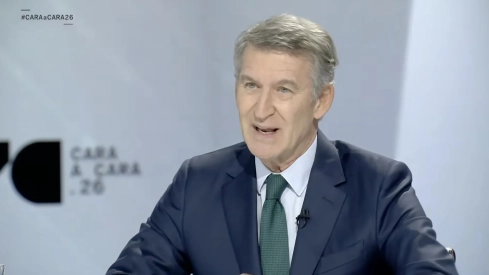
Alberto Núñez Feijóo closed his golden minute promising that he would always tell the truth. During Thursday's face-to-face with Pedro Sánchez, he had taken for granted judicial imputations that are not on record, attributed to Carlos Cuerpo a warning about the bankruptcy of pensions that the vice president did not utter, and converted sentence revisions into releases from prison. Documents and statistics contradict several of the accusations with which the PP leader sustained his offensive against the president.
The contrast also leaves incomplete data and misleading comparisons. Feijóo used advertisements from a real estate portal as if they described the entire rental market, mixed European transfers with loans, and omitted the context of figures on tax pressure. Some statements are false; others start from a real fact to which a meaning that it does not have is attributed.
The PSOE is not indicted and Carlos Cuerpo did not announce the bankruptcy of pensions
"That is why you are indicted for irregular financing in two summaries," Feijóo stated, addressing Sánchez. The accusation does not correspond to the known procedural situation: there is no record of a formal indictment of the president or the PSOE as a legal entity for that crime in the mentioned cases. In October, the judge of the National Court, Santiago Pedraz, refused to investigate the party in the Leire Díez case, considering that there were insufficient proceedings and a sufficient principle of evidence. The investigations into certain payments by the PSOE do not allow presenting an indictment that the judge has not issued as agreed.
The confusion between political responsibilities and judicial situations appeared in other reproaches. Feijóo said that David Sánchez had been sentenced "to nine years," omitting that the penalty is disqualification from public employment or office and passive suffrage, not imprisonment. He also transferred to the president the European investigation into the bracelets for protection against gender violence. The European Public Prosecutor's Office statement describes actions in the Ministry of Equality and the Court of Accounts for possible fraud in their acquisition; it does not announce a personal investigation against Sánchez.
Regarding pensions, Feijóo stated that Cuerpo had acknowledged on Onda Cero the risk of the system collapsing and added that he had the recording. The interview from October 16 states the opposite. The vice president defended the sustainability of pensions and explained that the retirement of the baby boom generation will increase spending over the next decades. His argument expressly distinguished this increase from alleged insolvency: anticipating more spending does not mean announcing that the system will go bankrupt.
Nor is there judicial support for the 1,400 releases that Feijóo attributed to the only yes is yes law. The balance of the General Council of the Judiciary (CGPJ), with data collected up to November 1, 2023, recorded at least 1,233 sentence reductions and 126 releases. The application of the norm led to sentence reductions and prison releases, but these are distinct categories: reducing a sentence does not necessarily mean leaving prison. Feijóo mixed them and used a total that does not match the official record.
Taxes and housing: the partial figures that Feijóo presented as a complete balance
The accusation of one hundred tax increases comes from a count by the Juan de Mariana Institute that groups tax modifications, social security contributions, the withdrawal of temporary reductions, and estimates on the non-deflation of personal income tax. It is not a homogeneous record of one hundred equivalent decisions nor does it explain how much more each taxpayer pays. In tax pressure, Feijóo omitted another difference: Spain was among the countries with the largest increases between 2024 and 2025, but its 38.1% of GDP was still below the 40.7% of the European Union and the 41.3% of the eurozone. A greater increase does not equate to bearing the highest level.
The popular candidate also stated that Spain had to return 80,000 million of the Next Generation funds, confusing non-repayable transfers with credits. European documentation on the review of the Spanish plan places the loan package at around 21,450 million; subsidies are subject to conditions and controls, but are not reimbursed as a loan. In terms of wages, the 3.8% loss of purchasing power he cited corresponds to an estimate by the Juan de Mariana Institute on net remunerations. It cannot be confused with the gross salary statistics from the National Institute of Statistics (INE), which went from about 24,009 euros in 2018 to 29,540.26 in 2024, an increase close to 23%, higher than the inflation of the period recorded in the verifications.
In housing, Feijóo reduced the Government's deliveries to 540 flats, a sum of promotions announced in press releases that does not constitute a complete record. Nor do the 400,000 homes he attributed to occupation come from an official census of flats withdrawn for that reason: the figure describes the evolution of ads on Idealista. Fewer ads do not necessarily mean fewer rented homes, because contract duration and tenant turnover also influence. The 69% decrease he cited for Barcelona presents the same problem: it cannot be automatically extrapolated from one portal to the entire market or attributed to a single cause.
Budget execution requires distinguishing between expenditure phases. Data published in the Official State Gazette place recognized Housing obligations in 2025 at around 95.8% of the definitive budget, while payments made were around 28.3%. Using this latter percentage to argue that the ministry left almost all its resources unexecuted mixes different indicators. It is also incomplete to minimize tourist flats due to their national weight, close to 1%: this average hides much larger concentrations in neighborhoods and municipalities where they compete with residential rental.
Ceuta and crime: inflated figures and an expulsion of foreigners already contemplated by law
Feijóo stated that there were only five Civil Guards at the Ceuta border when the massive entry occurred on July 30. The declassified reports show 243 agents distributed in shifts on that day, 48 of them in the night shift. This does not mean that all of them were simultaneously at the same border point, but it also does not support the description of a deployment reduced to five personnel. The candidate also raised the number of entries to 100,000 people, compared to the 80,000 reported by the Government, and compared arrivals to El Hierro with its census without specifying the period or how many people remained on the island.
His statement that sexual assaults with penetration had tripled also does not fit with the comparison between 2018 and 2025: the balances go from 2,744 to 5,370 known incidents, an increase close to 96%, not the 200% that tripling the figure would imply. This is a serious increase, but police statistics require considering legal changes, registration systems, and complaints. Furthermore, the 0.5% increase in criminal offenses in the first half of 2026 does not by itself prove an "exponential" growth in insecurity nor does it allow attributing it to immigration. This relationship requires an analysis that Feijóo replaced with the association between both phenomena.
The leader of the PP also presented as his own commitment the expulsion of foreigners who commit serious crimes. Spanish legislation already contemplates this possibility. Article 89 of the Penal Code regulates the substitution of prison sentences of more than one year for expulsion, with exceptions and guarantees, while Article 57 of the Immigration Law establishes grounds for expulsion through administrative proceedings. It is not a measure that needs to be created from scratch nor an automatic consequence for any foreigner who commits a crime.
The lack of precision also extended to his criticisms of foreign policy. Feijóo justified the PP's rejection of the Treaty of Friendship with France by claiming that it did not foresee electrical interconnections. The document published by the Cortes does include cooperation on energy interconnections. Its text foresees strategic ministerial dialogues on them during bilateral summits and periodic consultations between the operators and regulatory authorities of both countries.
Contact
We are listening. Get in touch.
