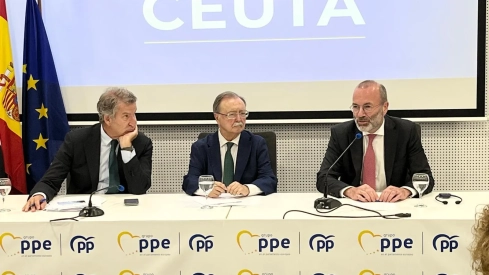
The leader of the PP, Alberto Núñez Feijóo, traveled this Monday to Ceuta along with the president of the European People's Party (EPP), Manfred Weber, where both met with the president of the autonomous city, Juan Jesús Vivas, to address the migratory crisis that the territory has been experiencing since the massive entry at the end of July. After the meeting, the three appeared jointly to demand greater involvement from Europe and to urge the Government of Pedro Sánchez to activate mechanisms to facilitate returns.
Feijóo has focused on community regulations and has argued that both the Migration and Asylum Pact and the Return Regulation contemplate ways to return "immediately" irregular immigrants who arrived in Ceuta. The president of the PP has accused the Executive of having "ignored" these mechanisms and has maintained that they would allow "streamlined management of returns if requested from Brussels."
During his speech, Feijóo demanded that Europe play an active role in responding to the crisis. "Europe has to contribute to the most important thing. Not only to solve the return of the 13,000 people who still remain irregularly in Europe, but it also has to contribute to preventing this from happening again," he said.
The popular leader has also defended that the community response must include the reinforcement of borders. In this sense, he has claimed that Ceuta and Melilla "are European territory because they are Spanish territory" and has demanded that "all European diplomatic channels must be activated to defend Spanishness and European identity."
Feijóo has insisted that the situation in Ceuta "transcends the migratory dimension" and has linked the crisis to the "integrity" of Europe. He has also highlighted that the European Commission is working on an Emergency mechanism that would allow "activating immediate returns of all citizens who enter a European State" and guaranteeing "the effective and real strengthening of the European border when it is attacked."
Feijóo demands that Sánchez "has to do his job"
The president of the PP has also directed his criticism towards the actions of the Spanish Government regarding Morocco. Feijóo has assured that the neighboring country has expressed its willingness to accept returned immigrants, including minors, which is why he has demanded that the Executive "has to do its job" in the legal and diplomatic fields.
Along these lines, he has demanded that bilateral channels with Morocco and dialogue channels with Brussels be activated to advance returns. Feijóo has argued that these returns are covered by both the European Pact on Migration and Asylum and the Return Directive.
To the return measures, he has added other demands for Ceuta. Among them, a "permanent, visible and continuous" presence of Frontex, an increase in European funding, and aid to extend the Tarajal breakwater. He has also proposed that Ceuta and Melilla could have a status similar to that of outermost regions, allowing them to have a priority role in accessing European funds.
Feijóo accuses the Government of looking for "a culprit"
The intervention of the PP leader has also been marked by his criticism of the central government's management of the crisis. Feijóo has described a "strategy" that, he pointed out, would be aimed at "finding a culprit" after the massive entry at the end of July.
The president of the popular party has reproached the Government for not having prevented the situation despite the precedents and warnings, for having "minimized" it, and for not having given a "quick" and "effective" response. He then accused the Executive of looking for someone to blame "for its incompetence."
Feijóo has especially focused his criticism on the Government's references to Juan Jesús Vivas. He has criticized the Executive for "pointing out" the president of Ceuta and has described this attitude as "miserable." In contrast, he has argued that Vivas understood the magnitude of the crisis from the first moment and remained "with his boots on."
The PP leader has even pointed to a possible "strategy" for the conflict to "become chronic" and "find a culprit." "It seems that now the culprit for this invasion in Ceuta is the president of the city of Ceuta. You will understand that it makes no sense," he stated.
Feijóo added that the Government could now try to "disassociate itself," and mentioned as examples the blackout, the Adamuz train accident, and the doctors' strike.
Finally, the president of the PP has expressed his solidarity with the people assaulted the previous night in Ceuta, including a deputy of the Ceuta Ya! Assembly, and has conveyed his support to the military who were attacked in recent days. "In a democracy, there is no cause, no disagreement, and no protest that can justify an act of violence," he concluded.
Add ElConstitucional.es as a preferred Google source for free.
Stay informed about all the latest breaking news with the best information. Against disinformation, for democracy and social rights.
