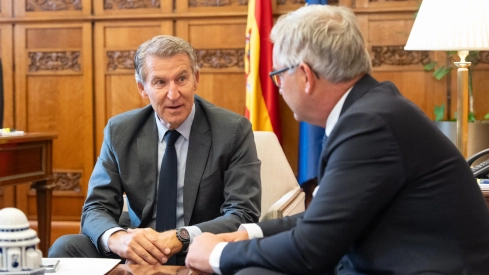
The president of the Popular Party, Alberto Núñez Feijóo, has made the Ceuta crisis one of the main fronts of his European agenda this Thursday. The opposition leader met in Congress with the European Commissioner for Home Affairs and Migration, Magnus Brunner, to whom he requested greater involvement from Brussels to facilitate the return of people who entered the autonomous city irregularly on July 30 and 31.
According to the version released by the PP after the meeting, Feijóo and Brunner agreed on the need to mobilize available resources to accelerate return procedures within Spanish and European legislation. The popular leader has also demanded that the European Union mediate with Morocco so that Rabat fulfills its commitment to readmit those who can be returned.
“Neither three months as he told the Spanish nor six as he said in Europe. This has to be resolved immediately,” Feijóo defended. His position is to return all people who entered irregularly, including minors, and reject their temporary transfer to the Peninsula.
The president of the PP considers that Spain faced an attack on its territorial integrity and openly uses the term “invasion” to refer to the massive entry. With this approach, he seeks to place the response in the field of European security and reinforce diplomatic pressure on Morocco.
Feijóo has also accused the Government of having acted late and of accumulating errors throughout the crisis. “They don't get anything right. Neither before nor during nor after the invasion,” he stated when referring to the recent decision of the National Court that has stopped the relocation proposed for some of the people housed in the port of Ceuta.
The return of everyone clashes with legal guarantees
The immediate return defended by Feijóo is conditioned by the guarantees of Spanish and European law. Authorities must individually study international protection requests, respect the principle of non-refoulement, and attend to the best interests of the child in cases affecting children and adolescents.
The European Pact on Migration and Asylum allows for streamlining procedures in situations of extraordinary pressure or instrumentalization of migratory flows, but maintains the right to request asylum and enhanced protection for minors. Collective expulsions are outside the legal framework, so any return requires identification, a file, and an appealable administrative decision.
The PP's own statement introduces this caution by placing returns within national and European legislation. Feijóo has asked Brussels to use its diplomatic capacity to get Morocco to accept legally appropriate returns and has presented this collaboration as the way to prevent the crisis from prolonging.
Among his proposals is also the permanent deployment of the European Border and Coast Guard Agency (Frontex) in Ceuta, Melilla, and the Canary Islands. The popular leader calls for a coordinated response that strengthens alerts, improves border surveillance, and allows for quicker action in future episodes.
Feijóo has invited Magnus Brunner to visit Ceuta to directly learn about the situation. The PP maintains that a trip planned for the summer ended up being postponed and now asks the Government to facilitate its realization as soon as possible.
The European Parliament reinforces the PP's offensive
The meeting was held on the same day that the European Parliament approved a resolution on Ceuta promoted by the European People's Party. The text, which has no binding effects, describes what happened as an "invasion," warns of the use of migration as an instrument of pressure, and demands that Morocco respect Spain's sovereignty and territorial integrity.
The initiative gathered the votes of the European People's Party, the liberals, and the three far-right groups in the Chamber. European socialists have voted against it. The resolution also links the extraordinary regularization approved by the Government with a possible "pull effect," a thesis disputed by the Executive and by progressive forces.
The document directs a warning to Rabat and proposes reviewing the cooperation relationship with Morocco if the authorities of the neighboring country refuse to collaborate with returns. Any suspension of the association agreement would, in any case, require new political and institutional steps and does not automatically derive from Thursday's vote.
Feijóo has celebrated the result and has assured that “today Europe has been with Ceuta and with Spain”. His offensive is completed with an article published in Politico, where he demands that the European Union get involved to prevent the crisis from becoming entrenched, and with his trip to Melilla, a city where he will remain until this Friday.
Next Monday he will travel again to Ceuta accompanied by the president of the European People's Party, Manfred Weber, in what will be his fourth visit to the autonomous city since the beginning of the crisis.
Add ElConstitucional.es as a preferred Google source for free.
Stay informed about all the latest breaking news with the best information. Against disinformation, for democracy and social rights.
