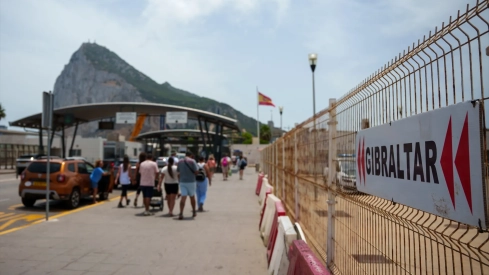
For over a century, anyone who wanted to enter or leave Gibraltar had to cross a fence. What began as a simple border control infrastructure ended up becoming one of the most recognizable symbols of the dispute over the sovereignty of the Rock. Now, that image has its days numbered.
Next July 15, the process to eliminate the historic barrier separating Gibraltar from La Línea de la Concepción will begin, putting an end to a structure that has marked the daily lives of several generations on both sides of the border. The history of the fence began in 1909, when British authorities installed a barrier on the isthmus connecting Gibraltar to the peninsula. Its function was to control access to the territory, although over the decades it ended up acquiring a political charge due to the historic disagreement between Spain and the United Kingdom over the sovereignty of the Rock.
However, the episode that turned the fence into an international symbol came in 1969. That year, the regime of dictator Francisco Franco ordered the complete closure of the land border after Gibraltarians rejected Spanish sovereignty. The decision left the territory isolated for thirteen years and affected thousands of workers and families in the Campo de Gibraltar who depended on the daily relationship with the Rock.
The situation began to normalize in 1982 with a partial opening for pedestrians, although circulation did not fully return to normal until February 1985. Since then, the fence has remained standing as a unique border within Europe.
Its disappearance now comes as a consequence of the agreement reached between the European Union and the United Kingdom to regulate Gibraltar's relationship with the community space after Brexit. The pact will de facto integrate the Rock into the Schengen area – an area formed by several European countries that have eliminated border controls between them. This means that a person can travel from one country to another without passing passport controls at the border, as if moving within the same country.
With the new system, immigration checks will no longer be carried out at the current border and will be moved to the port and airport of Gibraltar. The objective is to facilitate the transit of the thousands of people who cross daily between both territories for work or commercial reasons. The transformation will also change the appearance of the border area. The land currently occupied by controls will give way to pedestrian spaces, gardens and new infrastructures aimed at improving mobility between Gibraltar and La Línea.
However, the end of the fence will not mean the disappearance of security measures. The Gibraltarian authorities plan to implement new technological surveillance systems and reinforce police presence in the border area.
